Key takeaways
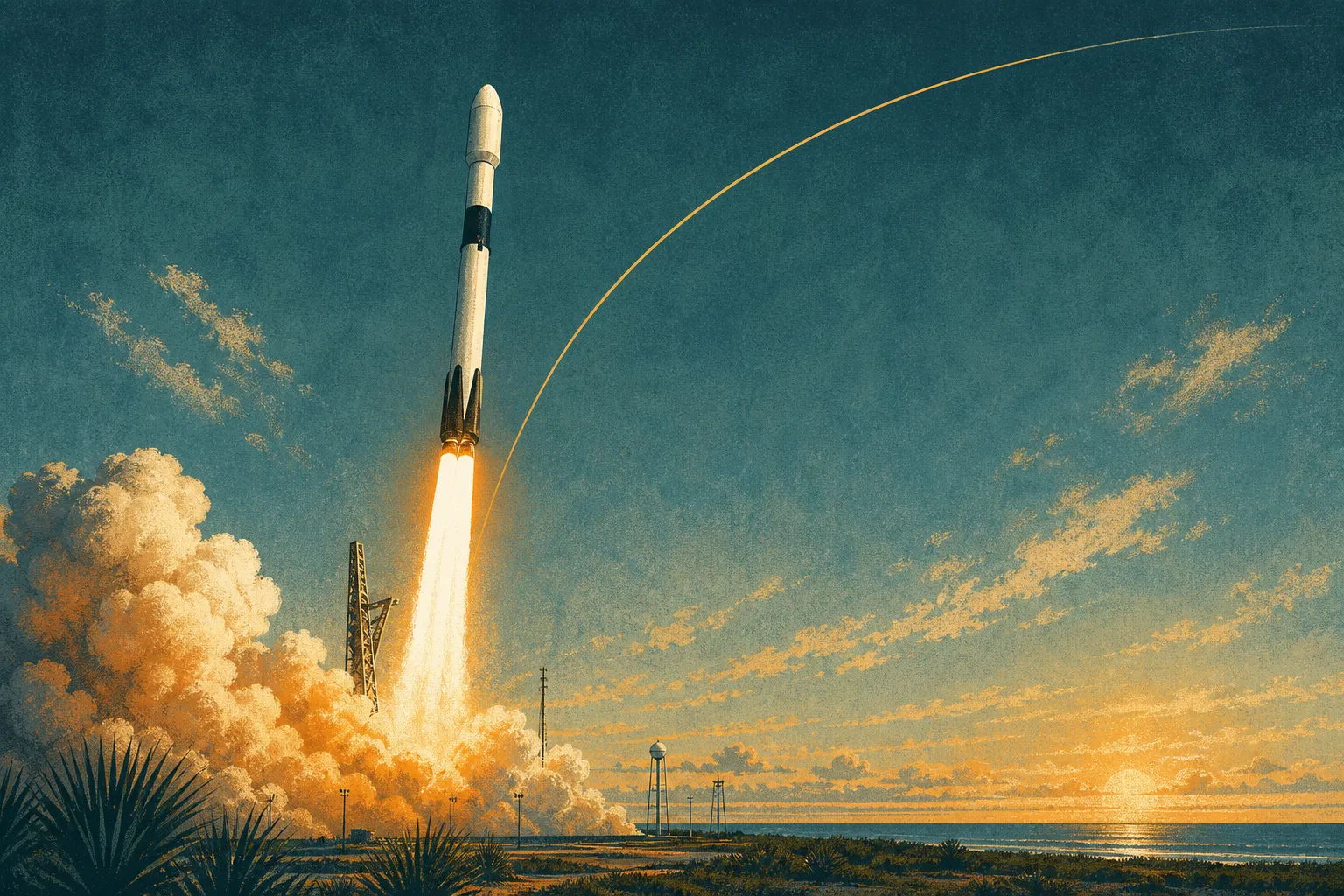
- The next SpaceX launch on Florida’s Space Coast is Starlink 10-39: a Falcon 9 carrying 29 Starlink V2 Mini satellites from SLC-40, Cape Canaveral Space Force Station, on Thursday, August 20, 2026. Window: 11:19 a.m. to 3:19 p.m. ET (1519–1919 UTC) per SpaceX, Florida Today, and Spaceflight Now.
- First-stage booster B1078 flies for the 30th time — prior missions include Crew-6, USSF-124, and 23 Starlink flights per SpaceX’s mission page. Landing target: droneship A Shortfall of Gravitas in the Atlantic — no Central Florida sonic booms.
- Trajectory: northeast. Space Force weather: ~80% go early in the window, falling to ~50% by window close (cumulus/anvil/electric-field threats). Live stream starts ~10 minutes before liftoff at spacex.com/launches/sl-10-39 and on X @SpaceX.
SpaceX launch calendars fill with Starlink batches, but Starlink 10-39 matters on Aug. 20 because the four-hour afternoon window is public, the booster is hitting flight number 30, and Florida Today published watch-zone maps the day before liftoff. If you are on I-95 Thursday, this is the mission name to search — not last Saturday’s sonic-boom return.
Mission basics
Official designation: Starlink Group 10-39 (Starlink 10-39). Payload: 29 Starlink V2 Mini broadband satellites to low-Earth orbit. Vehicle: Falcon 9 from Space Launch Complex 40 at Cape Canaveral Space Force Station — the south-side pad cluster, not Kennedy Space Center Pad 39A unless SpaceX reassigns (it has not as of Aug. 19 postings).
SpaceX’s published timeline shows fairing separation near T+2:58, first-stage landing near T+8:25, and satellite deploy roughly 61 minutes after liftoff following a second-stage burn sequence. Delays inside the window slide those times but not the mission profile.
Window and weather
Window opens 11:19 a.m. ET and closes 3:19 p.m. ET on Aug. 20, 2026. SpaceX can pick any instant inside that block; they do not announce the exact second until late in the countdown.
The 45th Weather Squadron forecast cited by Florida Today showed 80% favorable conditions early, dropping toward 50% by window end. Threats: cumulus clouds, anvil clouds, surface electric fields. NWS also flagged a 30% chance of showers and thunderstorms after 2 p.m. at the Cape — so a late-window attempt carries more scrub risk than an on-time open.
Heat matters for spectators more than rockets: Florida Today quoted afternoon highs near 94°F with light west-southwest wind. Pack water if you are on the beach line.
Booster B1078 and the droneship
Tail number B1078 supports this flight — its 30th launch per SpaceX and Spaceflight Now. Prior named missions on SpaceX’s list include Crew-6, SES mPOWER-B, USSF-124, BlueBird, Nusantara Lima, Starfall Demo, plus two dozen Starlink stacks.
Recovery plan: land on A Shortfall of Gravitas downrange in the Atlantic. That means no booster return to Landing Zone 1 and no Brevard County sonic booms — unlike the Aug. 15 mission that flew at night and came back to the Cape, part of a record 38-minute doubleheader SpaceX’s Kiko Dontchev highlighted on social media.
Where to watch in person
Northeast trajectory — visibility can extend north toward Jacksonville Beach and south past Vero Beach on clear days per Florida Today’s viewing guide, though haze and clouds shrink that fan.
- Playalinda Beach / Canaveral National Seashore: among the closest shore views; look south along the coast toward the pad line.
- Space View Park, Jetty Park, Cocoa Beach pier areas: classic Brevard spots; arrive early for parking.
- Volusia County beaches: look due south — farther but less pad-adjacent crowding.
Do not stop on causeway bridges against posted rules. Check park closures — seashore access can cap out on popular launch days.
Webcast and scrub rules
SpaceX webcast typically starts about 10 minutes before liftoff on the mission page: spacex.com/launches/sl-10-39 and the @SpaceX account on X. Florida Today also embeds live coverage at floridatoday.com/space for local weather and scrub updates.
A scrub inside the window resets the clock to the next eligible day — Starlink missions often recycle within 24–48 hours, but SpaceX has not posted a backup date as of Aug. 19. A scrub after window close means wait for a new range reservation.
After Saturday’s doubleheader
Starlink 10-39 follows an Aug. 15–16 burst that included two Falcon 9 launches a little over 38 minutes apart — company-record pace for Cape turnaround. Thursday’s afternoon slot is daylight, droneship landing, and commuter-friendly for Orlando and Melbourne day trips. It is not the same spectacle as a night LZ-1 return shake.
Starlink itself is consumer hardware once it reaches orbit — ground terminals pair with home routers like any other ISP backhaul. This post is the launch logistics layer; pairing satellites to your dish is SpaceX account setup, not pad viewing.
Launch schedules slip for weather, range, and vehicle checks. Confirm time and status on SpaceX and 45th Weather Squadron products day-of. Not affiliated with SpaceX or the U.S. Space Force.