Key takeaways
- Apple M5 Ultra is Apple’s first quad-die M-series chip — two dual-die M5 Max packages fused with UltraFusion — scaling to a 36-core CPU, 80-core GPU, up to 512 GB unified memory, and 1.2 TB/s bandwidth.
- New Mac Studio pairs M5 Max (from $2,499) or M5 Ultra (from $5,499) with Thunderbolt 5, Wi-Fi 7, PCIe Gen 6 storage, and optional multi-machine AI clustering.
- M6, Apple’s first 2 nm Mac chip, lands in the Mac mini from $899 alongside an M5 Pro tier at $1,699 — preorders open Aug. 25, shipping Sept. 22.
Apple’s August desktop drop is not one chip. It is two desks: a $899 Mac mini for everyone who wants local LLMs without a tower, and a Mac Studio that treats frontier models like a pro app — 512 GB of RAM on the ceiling config, Thunderbolt 5 wires for clustering four boxes into one inference pool.
Mode: rotate · Category: Gadgets
What Apple announced Aug. 25
Tuesday’s newsroom blast covers refreshed Mac Studio (M5 Max + M5 Ultra) and Mac mini (M6 + M5 Pro). Apple frames both around on-device AI — Neural Accelerators in the GPU, new Core AI framework in macOS 27, MLX for researchers — rather than cloud token bills.
Official pages: Mac Studio with M5 Max and M5 Ultra, M6 and M5 Ultra silicon deep dive, Mac mini with M6 and M5 Pro.
Roundup: TechCrunch on M5 Ultra and M6.
Apple M5 Ultra specs
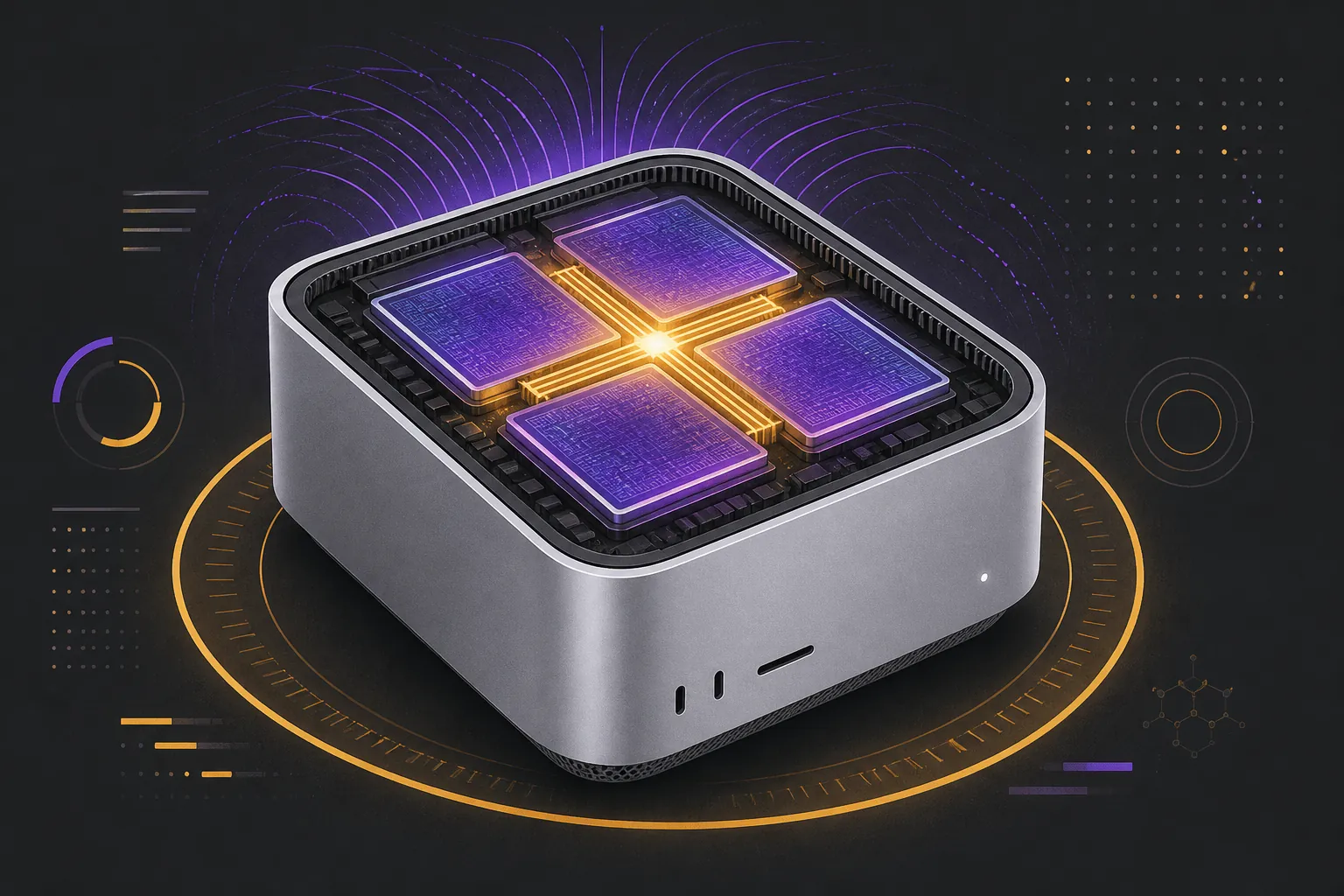
The headline silicon is Apple M5 Ultra — Apple’s “most powerful chip ever” and its first quad-die design. Two M5 Max dual-die packages join through next-gen UltraFusion with inter-die bandwidth above 4.4 TB/s, presenting as one SoC to software.
- CPU: up to 36 cores (12 super cores + 24 performance cores); binned config at 30 cores
- GPU: up to 80 cores with Neural Accelerators in each core; binned at 64 cores
- Memory: up to 512 GB unified RAM at 1.2 TB/s bandwidth — 50% more than M3 Ultra
- AI claims: up to 4.3× peak AI compute vs M3 Ultra; up to 9.8× vs M1 Ultra in Apple’s LM Studio tests
- Graphics: third-gen ray tracing, mesh shading, Dynamic Caching; up to 1.8× graphics vs prior gen in Apple’s Redshift/VFX benchmarks
Translation: Apple is selling a desk that can hold open-weight LLMs locally without renting GPU hours — privacy and predictable capex instead of per-token cloud math.
Mac Studio: M5 Max vs M5 Ultra
Both Studio configs share a compact chassis, Wi-Fi 7, Bluetooth 6, and Thunderbolt 5 (120 Gb/s) for the first time on Mac Studio. Storage moves to a PCIe Gen 6 SSD Apple says can run up to 2× faster than before.
M5 Max Mac Studio ($2,499 base): 18-core CPU, up to 40-core GPU, up to 128 GB RAM — the “serious pro” tier for music, photo, dev, and mid-size 3D.
M5 Ultra Mac Studio ($5,499 base): 30-core CPU / 64-core GPU / 96 GB RAM / 1 TB SSD in the entry SKU; configure up to the full 36/80 core and 512 GB RAM (512 GB configs ship late October).
Thunderbolt 5 clustering is the nerd feature: link multiple Mac Studios with RDMA, pool memory, and Apple claims up to 3× faster distributed inference vs a single box — a poor-man’s on-prem AI rack that still fits on a shelf.
M6 Mac mini: 2 nm entry desk
While M5 Ultra chases researchers, M6 chases the Mac mini crowd. Apple’s first 2 nm Mac chip packs a 12-core CPU (2 super + 4 performance + 6 efficiency), 12-core GPU with Neural Accelerators, dual 16-core Neural Engines, and up to 170 GB/s memory bandwidth.
Apple vs M4 Mac mini claims include up to 4× AI performance, 2× storage and graphics, and 40% faster CPU. Wi-Fi 7, Bluetooth 6, and 2.5 Gb Ethernet (10 Gb optional) round out I/O.
Mac mini line now splits:
- M6 from $899 — everyday productivity + on-device LLM prompt speed
- M5 Pro from $1,699 — heavier video, 3D, and “deskside agentic” workloads per Apple’s wording
Same ship window: preorders Aug. 25, arrival Sept. 22.
On-device AI and clustering
Hardware is half the pitch. macOS 27 adds Core AI for deploying models on Apple silicon, plus existing MLX for training/fine-tuning. Apple Intelligence and a beta “Siri AI” layer sit on top — still catching up to cloud models on raw capability, but strong on privacy-sensitive workflows (Face ID-style on-device pattern).
That puts Apple in the same conversation as other local-AI hardware bets this month — different form factor than a dedicated agent appliance, same thesis that some workloads should never leave the machine. Compare the agent-hardware angle in our Perplexity Portable Computer piece.
If your stack eventually lets agents spend money, wallet rails are moving faster than desk silicon — see Stripe Link agents for the banking side.
Prices and ship dates
| Model | Chip | US starting price | Ship |
|---|---|---|---|
| Mac mini | M6 | $899 | Sept. 22 |
| Mac mini | M5 Pro | $1,699 | Sept. 22 |
| Mac Studio | M5 Max | $2,499 | Sept. 22 |
| Mac Studio | M5 Ultra | $5,499 | Sept. 22 (512 GB RAM: late Oct.) |
Preorders live in the US and 29 other regions via apple.com/store and the Apple Store app. Apple Upgrade leasing starts at $48.99/mo for M5 Max Studio and $110.10/mo for M5 Ultra Studio (36-month terms, before tax/trade-in).
Who should buy which
- M6 Mac mini ($899) — best default for home users, students, and devs who want Apple silicon AI headroom without Studio money
- M5 Pro Mac mini ($1,699) — video, game dev, or always-on local agents that need more GPU sustained
- M5 Max Studio ($2,499) — pros who outgrew MacBook Pro thermals but do not need half a terabyte of RAM
- M5 Ultra Studio ($5,499+) — ML researchers, VFX, and teams building multi-Studio clusters for the largest open models
- Wait if you can — M3/M4 owners with working machines: this is a capability jump, not a broken-device fix; benchmark your actual apps against Apple’s footnotes before financing
Apple M5 Ultra is the clearest signal yet that Apple silicon’s next act is memory-bandwidth AI on the desk — quad dies, half-terabyte configs, and Thunderbolt clusters for when one box is not enough. The M6 Mac mini is the volume play: 2 nm efficiency for everyone else who just wants prompts to feel instant. Both ship in four weeks; the hard part is picking how much RAM you will wish you bought in 2027.
Prices and specs per Apple Newsroom Aug. 25, 2026. Performance claims are Apple-tested; your apps may differ. Not buying advice.