Key takeaways
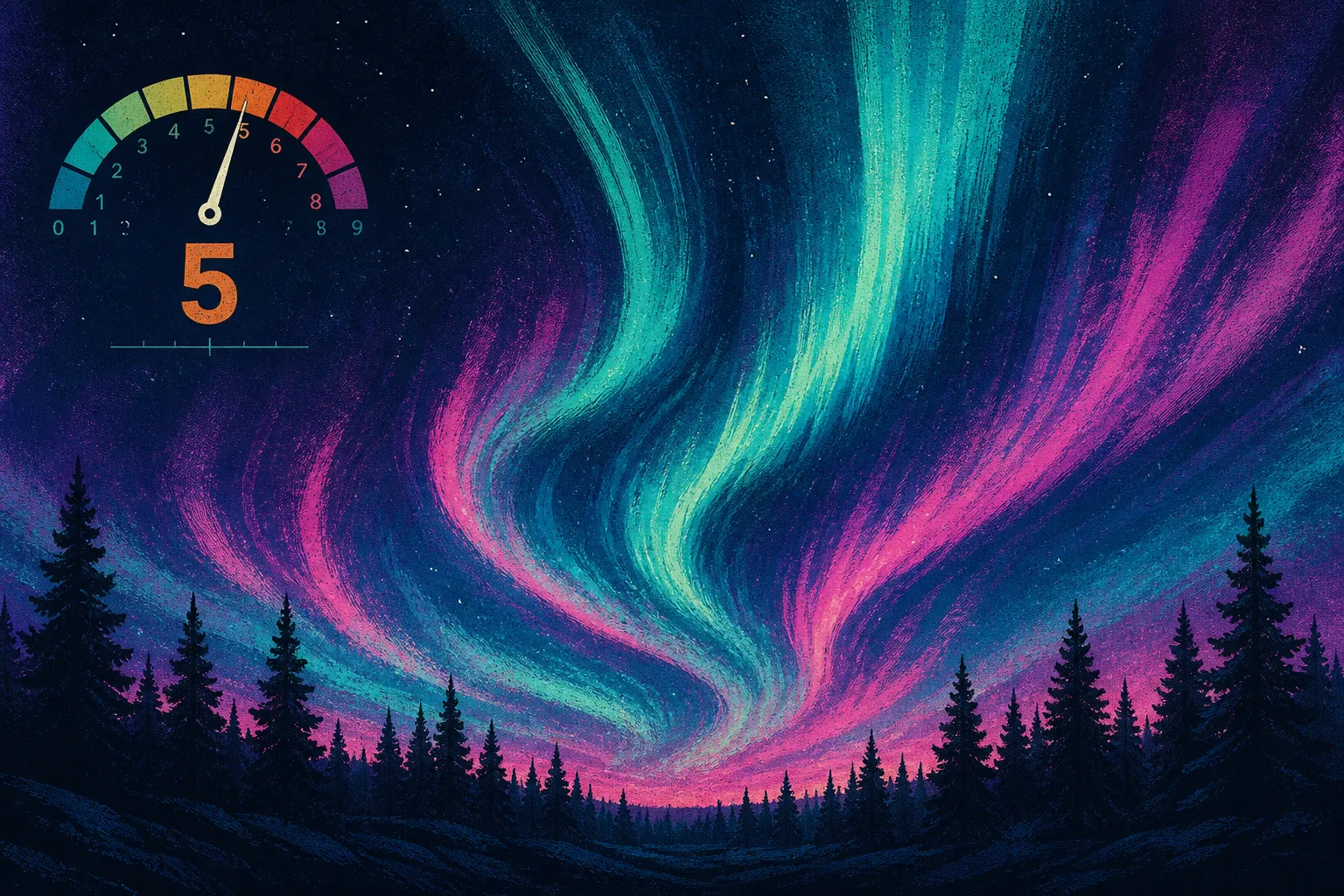
- NOAA’s Space Weather Prediction Center 3-Day Forecast issued August 19, 2026 at 1210 UTC calls G1 (Minor) geomagnetic storms likely on 19 Aug from an ongoing coronal hole high-speed stream (CH HSS). Greatest expected 3-hour Kp: 5.00 (G1 scale). Greatest observed Kp in the prior 24 hours was also 5.
- G1 is not May 2024’s G5 extreme event that pushed aurora deep into the Lower 48. Expect northern-tier visibility when skies are clear and dark — Maine, Michigan, Minnesota, North Dakota, Washington state, Alaska — not a guaranteed show from Atlanta or Dallas.
- Separate forecast line: 30% chance of R1–R2 radio blackouts Aug. 19–21 from solar flare activity — that is not the same mechanism as the geomagnetic storm. Live maps: NOAA aurora dashboard (experimental).
Aurora borealis searches tick up whenever NOAA posts a fresh geomagnetic storm line and photo threads start filling with “can I see it from Ohio?” The Aug. 19, 2026 answer starts with the scale letter: G1, minor — driven by a fast solar wind stream, not a cinematic coronal mass ejection wall. That means real northern lights for some latitudes tonight, and disappointment for everyone who expects Tampa skies to turn green.
What NOAA issued for Aug. 19
The operational product is the daily 3-Day Forecast (DAYTDF), not a viral screenshot. Key lines from the Aug. 19 issuance:
- Observed max Kp (24h): 5 → NOAA scale G1.
- Expected max Kp (Aug 19–21): 5.00 on Aug. 19 in the 03–06 UT block per the breakdown table.
- Rationale: “G1 (Minor) geomagnetic storms are likely on 19 Aug due to the ongoing negative CH HSS influence.”
Full text and updates live at SWPC 3-Day Forecast. Space weather moves in hours; refresh before you leave cell service.
G1 vs the viral May 2024 storm
Geomagnetic storms run G1 (minor) through G5 (extreme). G1 can nudge aurora equatorward a little on a dark night with high Kp sustained — think northern Minnesota, not central Florida. The May 2024 G5 event was a different class: Kp 9 territory, aurora reported unusually far south including parts of the Deep South in media coverage. People remember that weekend and assume every “geomagnetic storm” headline repeats it. It does not.
If your city needs Kp 7–8 on a normal night, a G1 cap near Kp 5 will not deliver. Rule-of-thumb maps used by aurora trackers put Scotland around Kp 5, northern U.S. states often Kp 5–7 depending on longitude and local light pollution.
Where the aurora borealis can show
Under G1 conditions with Kp near 5:
- Good bets: northern Alaska, Canada, Iceland, Scandinavia; in the Lower 48 — northern Maine, upper Michigan, Minnesota, Montana, Washington, North Dakota, sometimes upstate New York if geomagnetic activity stays elevated and clouds break.
- Long shots without stronger storms: mid-Atlantic and Southeast metro areas, desert Southwest, most of Texas and Florida.
You need three layers: geomagnetic activity high enough, nighttime at your longitude, and clear sky. A G1 alert with full cloud cover over Minneapolis still means nothing visible from the parking lot.
Look north (in the Northern Hemisphere) away from city glow. Phone cameras often pick up faint green where eyes see gray — that is sensor gain, not guaranteed naked-eye color.
How to check before you drive north
NOAA’s experimental aurora dashboard shows tonight’s and tomorrow’s viewline forecasts plus a short-term hemispheric animation. Pair it with your local NWS cloud forecast — space weather without sky clarity is half the puzzle.
The planetary K-index updates in 3-hour blocks. A spike at 03–06 UT matters for Europe; U.S. evening viewers should watch the 18–21 UT and 21–00 UT rows on Aug. 19 in the forecast table and compare to local sunset.
Do not stare at the sun expecting aurora. Do not confuse this with a solar eclipse window. Different phenomena, different safety rules.
Radio blackouts are a separate risk
The same Aug. 19 NOAA package lists 30% probability of R1–R2 (Minor–Moderate) radio blackouts on Aug. 19–21 from solar X-ray flare activity — not from the CH HSS wind stream driving the geomagnetic storm. Ham operators, aviation HF, and some GPS-sensitive workflows watch R-scale alerts; casual aurora chasers usually do not feel R1 unless you are already marginal on HF.
Solar radiation storms (S-scale) were below thresholds in the Aug. 19 forecast — no S1+ expected.
Power grid and the CH HSS driver
G1 storm bulletins mention possible weak power grid fluctuations from geomagnetically induced currents. Utilities plan for this on auroral latitudes; G1 is routine compared with Carrington-class talk. The driver here is a coronal hole high-speed stream — open magnetic field lines on the sun letting wind pour out faster than ambient slow solar wind. It is not as photogenic as a halo CME on coronagraph GIFs, but it is enough to bump Kp to 5 for a night.
Aug. 20–21 in the same forecast show lower predicted Kp segments (many 2–4 blocks) — the headline night is Aug. 19 unless SWPC extends the CH HSS influence in a later issuance.
Educational only. Aurora visibility is not guaranteed. NOAA products update frequently; confirm current Kp, cloud cover, and local light pollution before travel. Not aviation or emergency guidance.