Key takeaways
- Canada tariffs escalated Monday, Aug. 24, 2026, when President Trump said the U.S. will impose 50% duties on all Canadian cars, trucks, automotive parts, and steel starting Jan. 1, 2027 — after weekend trade talks collapsed and Prime Minister Mark Carney suspended negotiations.
- Separate 50% U.S. tariffs on roughly $20 billion in Canadian imports — dairy, wine, wood, furniture, cement, ceramics, hockey sticks, and more — took effect Saturday, Aug. 22 under Section 338 of the Tariff Act of 1930. Non-U.S. autos already face 25%; Canadian steel was already at 50%.
- Carney pledged dollar-for-dollar retaliation targeting U.S. steel, dairy, appliances, agricultural equipment, pulp and paper, and electronics — effective the Tuesday after Labor Day, Sept. 8. The Canadian dollar fell against major currencies Monday as ING warned Canada’s open economy has more to lose.
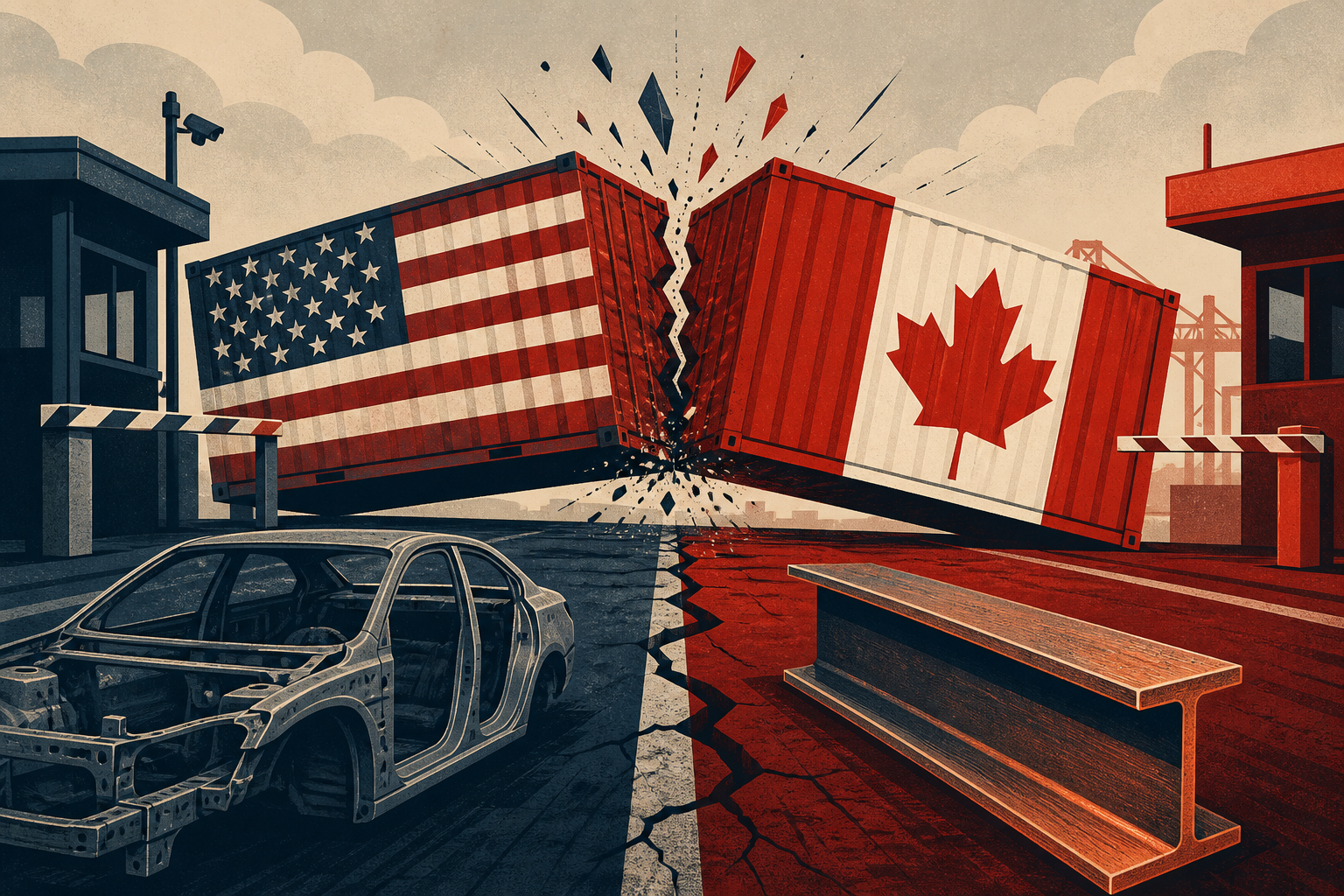
Canada tariffs were supposed to be in a three-day negotiating window. That window closed ugly. Washington imposed 50% duties on a $20 billion slice of Canadian goods, Ottawa ordered negotiators home, and Trump answered Monday with a 2027 ultimatum on the integrated auto and steel supply chain that built North American manufacturing for three decades. This is no longer a tariff pause story — it is a trade-war calendar with dates attached.
How Canada tariffs went from pause to trade war
Five days ago Trump paused 50% Canada tariffs less than two hours before an Aug. 19 deadline, citing a near-complete deal on roughly $20 billion in imports. Negotiators got until Aug. 21. Coverage at the time flagged auto tariff levels as the main sticking point — see Trump pauses 50% Canada tariffs.
By Friday Aug. 22 the talks broke down. Carney suspended negotiations and pulled Canada’s team back to Ottawa. Hours later the U.S. implemented the 50% levies anyway. Monday Trump added the forward-dated auto-and-steel escalation. The sequence matters: markets priced hope on Aug. 19, repriced failure on Aug. 22, and repriced structural auto risk on Aug. 24.
Reporting: Reuters on failed trade talks, CNBC on the Canada-U.S. trade war, CBS News on Trump’s 2027 auto tariffs.
The Aug. 22 duties already in force
The live round is not hypothetical. Effective Saturday Aug. 22, the U.S. imposed 50% tariffs on hundreds of Canadian product lines totaling about $20 billion in annual import value. Categories cited across wire copy include:
- Dairy and agricultural products
- Wine and beverages
- Wood products and softwood lumber
- Furniture, cement, and ceramics
- Hockey sticks and sporting goods
- Other consumer and industrial goods beyond the auto core
Legal authority: Section 338 of the Tariff Act of 1930 — the same emergency trade lever Trump used in prior rounds of the Canada dispute. These duties hit now; they are separate from the Jan. 1, 2027 auto-and-steel threat Trump posted Monday.
Trump’s Jan. 1, 2027 auto and steel threat
Monday on Truth Social, Trump wrote that starting Jan. 1, 2027, tariffs on all Canadian cars and trucks — “large and small” — plus automotive parts and steel, will rise to 50%. He accused Canada of “ripping off” the United States for years and repeated that vehicles built in the U.S. are not subject to the levies.
Context for the numbers:
- Non-U.S. automobiles and parts currently face a 25% tariff in the broader Trump trade regime
- Imported Canadian steel already carries a 50% levy — Monday’s post locks that level forward and sweeps passenger vehicles and parts to match
- The 2027 date gives automakers a planning horizon — and a lobbying window — but integrated plants cannot re-source cross-border content in four months
Fox Business and CBS both noted the announcement landed the same day U.S. equity markets punished Detroit: shares of General Motors and Ford moved lower on fear that higher input costs and retaliatory Canadian duties hit plants on both sides of the border.
Why Ottawa and Washington blame each other
Each capital has a story. Neither story includes a signed deal.
Carney’s version: Washington made a last-minute “power play” — demanding restrictions on Canada’s ability to negotiate trade agreements with other countries, pushing terms on autos, and encroaching on cultural protections including French-language rules. He said the U.S. “asked too much and offered too little” and that he would not “compromise Canada’s sovereignty or undermine our key industries.”
Washington’s version: U.S. Trade Representative Jamieson Greer told the New York Times the U.S. offered substantial concessions — cutting the “majority” of Canadian steel exports to 25% up to a quota (above-quota stays 50%), lowering aluminum to 25% without quota, reducing passenger-vehicle tariffs, suspending the since-enacted duties, and eliminating a lumber tariff. Canada “simply wanted more,” Greer said on CNBC Monday.
Canada’s ambassador Kirsten Hillman (via envoy comments reported by the National Post) said the written text at the table diverged from what Ottawa believed it had agreed to — a classic trade-negotiation failure mode when verbal understandings do not survive legal scrubbing.
Trade attorney Patrick Childress, a former USTR official now at Holland & Knight, told CBS the agenda may have become “too expansive and multifaceted to finalize in the limited time available” — and that Canada’s retaliation vow “will raise the temperature” for any restart.
Carney’s Sept. 8 retaliation plan
Carney pledged to match U.S. tariffs dollar for dollar. Canada’s countermeasures take effect the Tuesday after Labor Day — Sept. 8, 2026 — unless the trajectory changes. Targeted U.S. sectors named publicly:
- Steel
- Dairy
- Appliances
- Agricultural equipment
- Pulp and paper
- Electronics
Full product lists are promised “in the coming days.” Dollar-for-dollar retaliation is designed for political symmetry — every Canadian headline on U.S. pain gets a U.S. headline on Canadian pain — but it also raises prices on both sides of the 5,525-mile border.
Trump has pledged to escalate further if Carney proceeds. Bessent echoed the frustration at Monday’s Iran sanctions presser, saying Canada rejected a “quite a good deal” and blaming Carney’s “anti-American, anti-Trump platform.” Trade and geopolitics stacked into the same August news cycle as Operation Economic Outcast.
Autos, GM, Ford, and the medium-duty fight
The breakdown was not abstract. Negotiators fought over medium and heavy vehicles — the tariff treatment Detroit’s Canadian assembly network needs. Canada’s envoy said Ottawa “needed medium and heavy duty vehicles to be included” in relief; the U.S. resisted cutting those tariffs. That directly affects General Motors and Ford, which operate major Canadian plants feeding U.S. dealers.
North American auto supply chains run on repeated border crossings: engines, transmissions, stampings, and wiring harnesses can cross multiple times before a VIN exists. A 25% tariff is already a margin shock; 50% in 2027 is a structural break unless rules-of-origin credits or USMCA exemptions reappear in a revived deal.
Trump’s Monday post explicitly exempts vehicles “built in the U.S.” — pushing OEMs toward domestic content aggregation but punishing Canadian final assembly and cross-border parts loops that USMCA was written to protect.
Markets: Canadian dollar and cross-border supply chains
The Canadian dollar weakened against the U.S. dollar and other majors Monday after the weekend tariff implementation. ING strategists noted Canada, “as a smaller, more open economy,” has more to lose from a sustained fight — growth forecasts and business investment typically take the first hit when your largest trading partner doubles duties on export pillars.
Broader Monday context: U.S. indexes were mixed (Dow up, Nasdaq down on chips), oil fell on Iran sanction headlines, and safe-haven flows bid gold — see gold price for the precious-metals read-through. The loonie does not trade in isolation from U.S. rates either; long-end Treasury stress and Bessent buybacks still set the FX backdrop: Treasury buyback August 2026.
For importers, the practical question is not Twitter rhetoric but customs entries on Aug. 22 forward — which HTS lines cleared at 50%, which invoices need re-pricing, and whether bonded warehouse strategies still pencil at half the prior margin.
What this means for USMCA renewal
The U.S.-Mexico-Canada Agreement — the successor to NAFTA Trump signed in his first term — assumed tariff predictability and side-letter protections both sides now treat as optional. A 50% bilateral stack on $20 billion in goods plus a 2027 auto-and-steel cliff makes the 2026 USMCA review conversation harder, not easier.
Near-term calendar for businesses and investors:
- Now – Sept. 7: U.S. 50% duties on ~$20B Canadian goods in effect; supply chains re-route or absorb
- Sept. 8: Canadian retaliatory tariffs scheduled unless talks restart
- Jan. 1, 2027: Trump’s posted 50% rate on Canadian autos, parts, and steel — unless a deal intervenes
- Same week: U.S. macro catalysts continue — July PCE Aug. 26, Kevin Warsh Jackson Hole speech Aug. 28, NVIDIA earnings — that move rates and FX independently of Ottawa
Canada tariffs in August 2026 are no longer a deadline drama with a pause button. They are layered duties — live on consumer goods, promised on autos, matched in retaliation — with sovereignty language from Carney and “they wanted more” from Greer. Until one side blinks, the border is a tax line, not a trade lane.
News and policy commentary only. Tariff rates, product lists, and retaliation schedules change. Confirm USTR, CBSA, and CBP notices before import planning. Not legal or investment advice.