Key takeaways
- GM stock fell about 1–2% Monday, Aug. 24, 2026, trading near $86 after President Trump said 50% tariffs on Canadian cars, trucks, auto parts, and steel take effect Jan. 1, 2027. Ford and Stellantis dropped roughly 3–4% — sharper than GM on the same headline.
- The tariff is not live yet; markets are repricing cross-border supply chains built under USMCA. A collapsed deal would have cut the existing 25% auto tariff on Canadian-built vehicles to 15% — negotiators deadlocked over whether medium and heavy trucks qualified.
- Canada retaliates Sept. 8 with dollar-for-dollar duties. GM previously flagged $4–5 billion in tariff-related losses. Full trade-war context: Canada tariffs trade war.
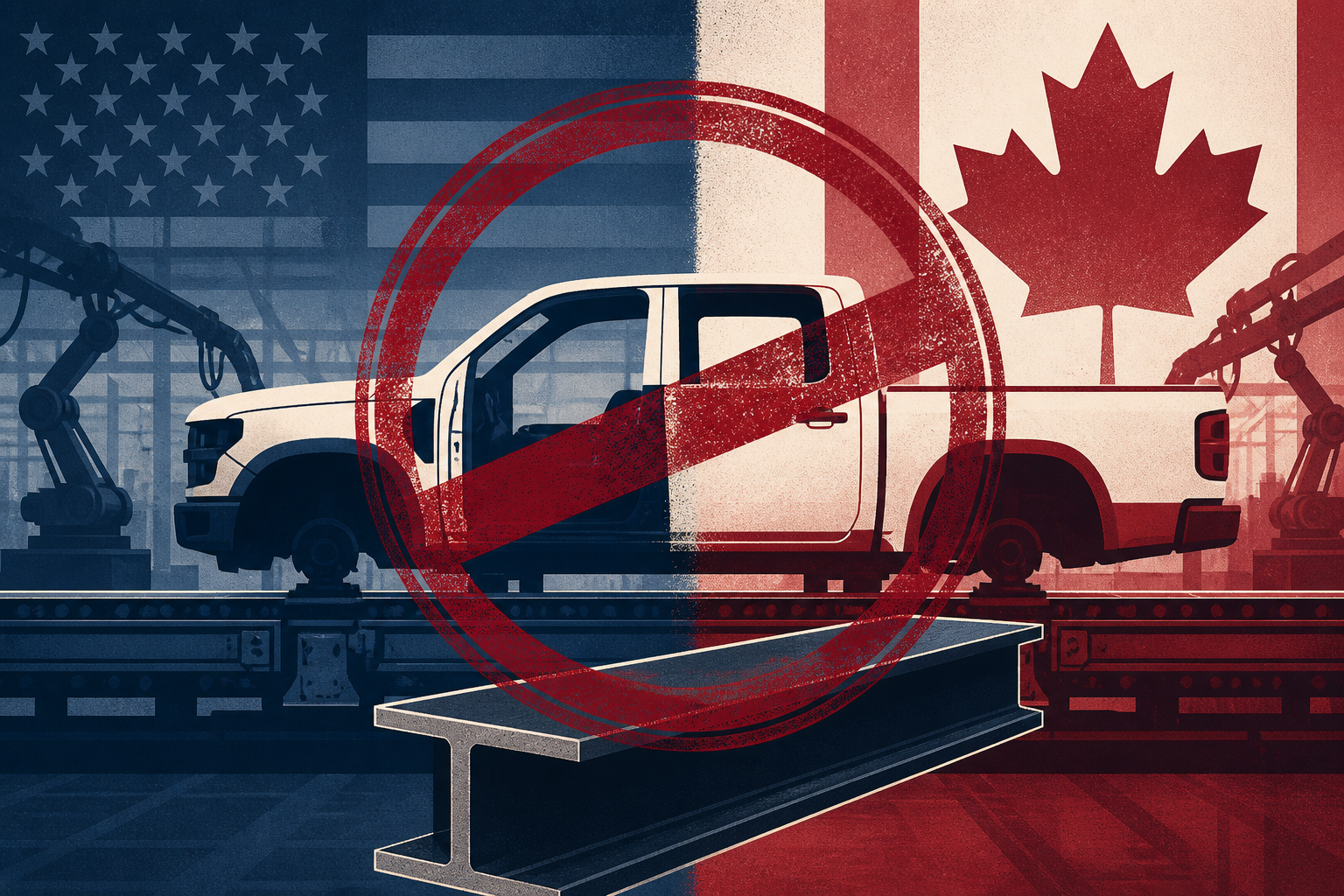
GM stock is how equity markets price a border tax on the integrated North American auto machine. Donald Trump did not impose 50% duties Monday — he posted a Jan. 1, 2027 start date on Truth Social after weekend trade talks collapsed. Detroit sold off anyway. When Oshawa, Windsor, and Kentucky share a VIN, a tariff scheduled 16 months out still changes discount rates on every cross-border part today.
Monday’s GM stock reaction — and Detroit peers
Aug. 24 mid-morning quotes from coverage:
- General Motors (GM): down ~1.2–2% near $86.28 (Benzinga / 24/7 Wall St.)
- Ford (F): down ~3–4% near $13.87 — Ford was up ~17% YTD through Friday, so Monday erased a slice of that gain
- Stellantis (STLA): down ~3–4% near $5.19 — already trading below prior year-end levels, magnifying the hit
- Tesla (TSLA): down ~2.6% in some sessions — less Canadian assembly exposure, still caught in tariff-risk sentiment
The divergence matters: Ford and Stellantis absorbed the announcement more sharply than GM despite shared cross-border exposure. No company-specific explanation emerged from the White House or OEMs — the tape may reflect positioning, leverage to Canadian content, or simply which names traders hit first in a macro headline.
Reporting: 24/7 Wall St. on Detroit stock moves, Benzinga on tariff stock reactions.
What Trump announced for Jan. 1, 2027
Monday Truth Social post (also covered by CBS, Fox Business, Benzinga): starting Jan. 1, 2027, tariffs on all Canadian cars and trucks — large and small — plus automotive parts and steel, rise to 50%. Vehicles built in the U.S. are exempt from the levies in Trump’s framing.
Context investors must separate:
- Not effective today: Monday’s GM stock move reprices an announced future cost — months remain for negotiations, exemptions, or USMCA legal fights
- Live duties already exist: separate 50% U.S. tariffs on ~$20 billion in Canadian goods took effect Aug. 22 after talks failed — distinct from the 2027 auto cliff
- Current auto tariff baseline: non-U.S. automobiles and parts face 25% in the broader Trump trade regime; Canadian steel already at 50%
- Deal that died: would have cut the tariff on Canadian-built vehicles to 15% — better than 25%, far better than 50%
Benzinga noted statutory tariffs remain in force despite the Supreme Court’s 2026 ruling limiting IEEPA tariff authority — Section 232 and Section 301 measures passed by Congress still apply to steel, aluminum, and autos.
Why medium and heavy trucks sank the deal
Automotive News and Motor1 reporting: the framework looked simple — cut auto duties from 25% to 15% — until negotiators fought over which vehicles qualified.
Washington wanted the break for light vehicles only, leaving medium and heavy trucks at higher rates. Ottawa insisted relief cover the full assembly industry — cars, light trucks, medium trucks, and heavy-duty units. Carney told reporters truck tariffs played a major role in killing the agreement.
Canada’s ambassador Mark Wiseman told Bloomberg Canada “needed medium and heavy duty vehicles to be included” and could not accept terms that gut Canadian truck assembly — directly naming GM and Ford operations in Canada. Both companies recently reached tentative agreements with Canada’s Unifor union per CBT News — labor peace on one side of the border does not fix tariff math on the other.
Deep dive on the diplomatic collapse: Canada tariffs trade war August 2026. Earlier pause window: Trump pauses 50% Canada tariffs.
Cross-border plants: GM, Ford, Stellantis exposure
Detroit’s North American model assumes parts and vehicles cross the border multiple times before a dealer delivery:
- GM: significant Canadian assembly footprint (Oshawa and other operations cited in trade coverage) feeding U.S. dealers — medium/heavy truck lines central to the failed deal
- Ford: Oakville, Ontario and other Canadian sites in the integrated network; Monday’s sharper −4% may reflect higher perceived Canadian content share or trader positioning
- Stellantis: Windsor minivan/plant history and broader NAFTA-era supply loops — STLA’s lower share price amplifies percentage moves for retail holders
USMCA rules-of-origin credits let OEMs aggregate North American content to reduce duty exposure on qualifying vehicles. A blunt 50% tariff on Canadian parts — if applied without content carve-outs — breaks the math that USMCA was written to preserve. Benzinga flagged uncertainty whether the proposed 2027 rate would preserve existing treatment limiting duties to non-U.S. content in Canadian vehicles — a detail that could swing billions in effective rates.
Three paths for automakers: absorb, relocate, or raise MSRPs
Business Upturn’s Aug. 24 framing for GM stock and peers:
- Absorb: take the tariff hit and accept lower margins — tough when GM already warned on multi-billion-dollar tariff costs
- Relocate: shift sourcing and assembly to minimize Canadian content — slow, capital-intensive, cannot flip before Jan. 2027
- Pass through: raise vehicle prices and let consumers fund the border tax — politically toxic in a soft retail environment
Steel at 50% already raises body-in-white costs. Parts at 50% hit wiring harnesses, stampings, and powertrain components that shuttle between Ontario and Michigan daily. Even a delayed effective date forces procurement teams to model scenarios now — which is why GM stock moved on a 2027 headline.
GM’s $4–5 billion tariff warning
Motor1 cited prior GM guidance: the company expects to lose roughly $4 to 5 billion from tariffs — a figure that predates Monday’s 2027 escalation but frames how management already prices trade risk.
For GM stock investors, the question is whether Monday’s Truth Social post:
- Is negotiable leverage ahead of another deal attempt
- Locks in a structural margin headwind through the next product cycle
- Accelerates reshoring capex that helps long-term but hurts near-term free cash flow
None of the Detroit Three issued detailed Monday responses in early coverage — the market spoke first.
Canada’s Sept. 8 retaliation calendar
Carney pledged dollar-for-dollar counter-tariffs effective the Tuesday after Labor Day — Sept. 8, 2026. Target sectors include U.S. steel, dairy, appliances, agricultural equipment, pulp and paper, and electronics.
Retaliation hits U.S. exporters and can raise input costs for Canadian plants that American OEMs rely on — a two-way pinch. Carney estimated the live U.S. 50% wave may hit closer to $28 billion in Canadian goods versus the initial $20 billion figure — autos and trucks inside that stack.
Trump has pledged to escalate further if Canada proceeds. Bessent echoed frustration at Monday’s Iran presser, blaming Carney for rejecting a “quite a good deal.” Trade and geopolitics share the same August news cycle: Operation Economic Outcast.
What investors watch next
GM stock checklist:
- Negotiation restart? Jan. 2027 leaves room — but Sept. 8 retaliation may poison talks first
- Medium/heavy truck treatment — any deal must answer Wiseman’s red line or Detroit’s Canadian truck lines stay exposed
- Non-U.S. content carve-out — legal text matters more than Truth Social adjectives
- Q3 guidance updates — watch for revised tariff loss estimates on GM, Ford, Stellantis calls
- Macro overlay: July PCE Aug. 26 and consumer confidence — auto demand is rate- and price-sensitive: PCE inflation August 2026
- Steel tariffs: U.S. steelmakers reportedly rallied on Benzinga’s Monday tape while Detroit fell — input cost bifurcation
GM stock on Aug. 24 is a −2% move on a tariff that does not bind until 2027 — because the market already priced a 15% deal dying over medium trucks. Ford and Stellantis fell harder on the same news. Until Ottawa and Washington rewrite the vehicle list, Detroit trades like every cross-border bolt is taxed twice.
Company and market commentary only. Tariff rates, trade text, and stock prices change. Not investment advice. Confirm USTR and company filings before trading.