Key takeaways
- The Hugging Face Microduck opened for preorder on Aug. 27, 2026 at $399 before tax and shipping — a 25 cm, ~780 g biped from Pollen Robotics in Bordeaux.
- Out of the box it walks, crouches, roller-skates, picks up objects with a grasping beak (up to ~800 g), and stands back up from many falls. Software is Apache 2.0; mechanical and electronic design files are not.
- First deliveries are targeted before Christmas 2026 in North America, Europe, the UK, plus Japan and South Korea. Payment is taken at checkout; cancel before dispatch for a full refund.
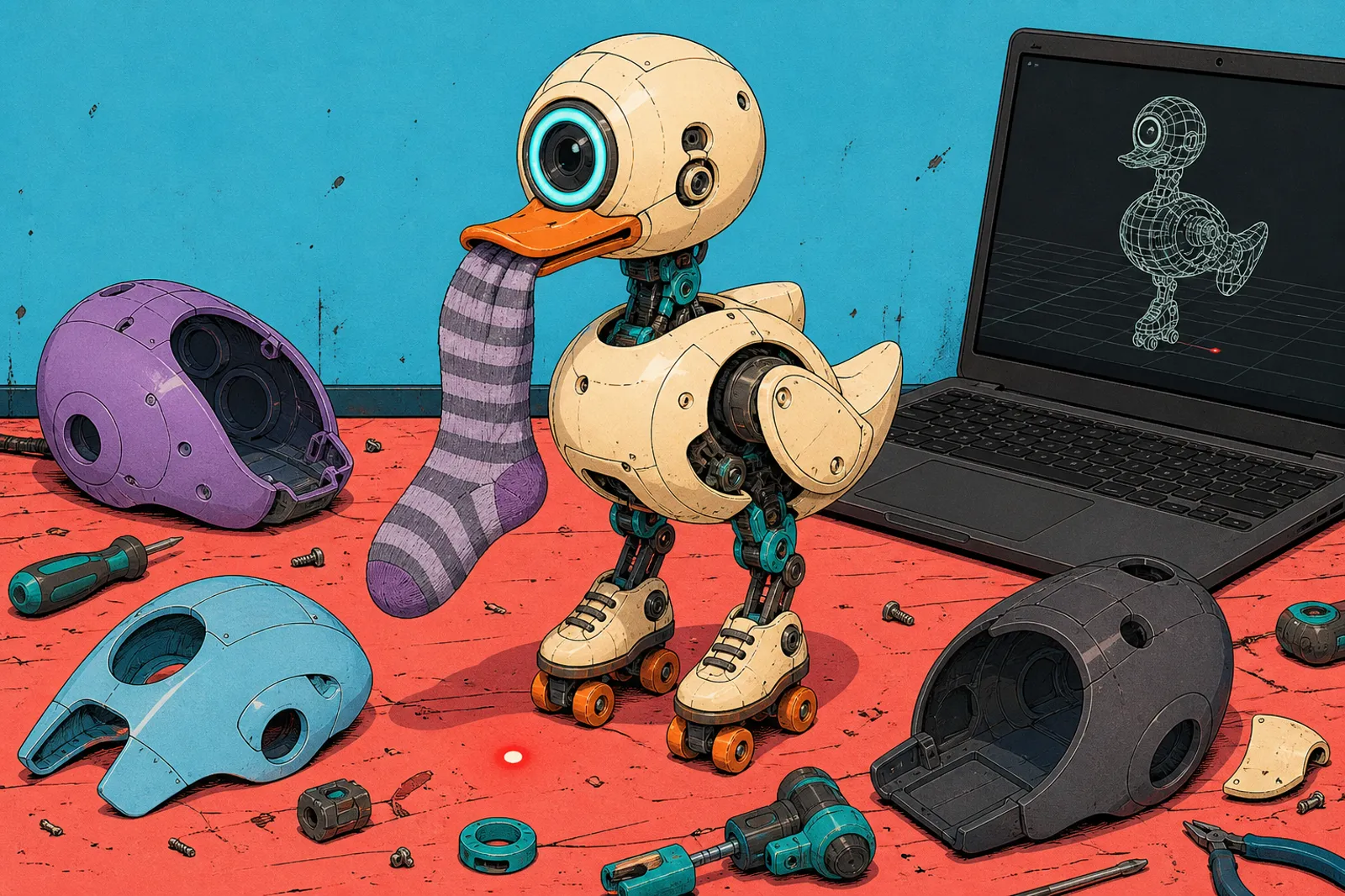
Pollen Robotics, Hugging Face’s Bordeaux hardware shop, put a 25-centimeter biped on sale Thursday that looks like a lampshade and moves like a duck. The Hugging Face Microduck is $399 before tax and shipping, ships before Christmas if the calendar holds, and is the rare consumer robot that is supposed to fall over on purpose.
Mode: rotate · Category: What’s Popular
What launched on Aug. 27
Preorders opened the same day Pollen published the Meet Microduck post and stocked the store listing. Hugging Face CEO Clément Delangue framed it as “an open-source robot you can teach new tricks with reinforcement learning” — walk, pick things up, get back up, even roller-skate.
This is Pollen’s second consumer robot after Reachy Mini, the desktop talker that the company says has now shipped more than 10,000 units. Reachy Mini is built to interact. Microduck is built to act: leave the desk, carry something, eat the floor, recover, try again. Official pages: Microduck product and the press kit fact sheet.
Launch coverage: TechCrunch on the $399 duck, The Verge on the rollerskating biped, Popular Science on falling on purpose.
Size, sensors, and the seven tricks in the box
Store and press-kit numbers, treated as launch specs (camera FOV and some radio details are still marked provisional):
- 25 cm tall, 14 cm wide, 780 g (under 800 g)
- 15 motors across legs, head, and neck
- Wide-angle front camera, compact 8×8 ToF LiDAR, two IMUs (body + head)
- Articulated grasping beak; two NFC antennas (head and beak)
- Mics and speaker; Rockchip RK3566 plus an AI accelerator; 1 GB RAM, 32 GB storage
- Wi-Fi and Bluetooth; removable NP-F550 battery (~1 hour, 2600 mAh)
- Gamepad in the box; seven trained moves at launch; onboard policy loop at 50 Hz
Demo clips show sock-and-marker grabs, a laser-dot follow, soccer kicks, and tiny roller skates. Pollen told Popular Science those clips are the shipping skill set, not vapor. The beak is the gripper: whole body lowers, beak closes, object comes along — rated up to about 800 g.
It does not talk. Each unit generates a private audio identity the first time it wakes up and keeps that voice for life — “closer to a creature than an assistant,” in Pollen’s line. That is the toy hook. The developer hook is the same chassis.
Open-source software — not open hardware
Do not call it open-source hardware. Pollen’s press kit is explicit: the open-source claim covers the software stack. Mechanical and electronic design files are not public, so nobody is supposed to fab a clone and sell it.
The New Stack’s walkthrough adds that the code is Apache 2.0 and the hardware files sit on a non-commercial license. The main repo is pollen-robotics/microduck (SDK and robot software). A separate Microduck RL repo holds the training and sim-to-real tools. Software is meant to be public before the first robots ship.
How you actually teach it new tricks
The pitch is sim-to-real, not “press a button and it learns your living room.” You train a behavior in a physics simulator, drop the policy on the real duck, watch it fail, then go back to the twin.
New Stack’s read of the GitHub notes: a walking policy trained across 4,096 virtual ducks in parallel can produce a usable gait in one to two hours. The repo registers about 13 task families, including a forward roll and six built around passive wheels under the feet. Training wants an Nvidia GPU, or Hugging Face’s own infrastructure. The sim stack is MuJoCo Warp on Nvidia’s Warp framework; mjlab underneath reimplements the Isaac Lab API.
That is why a $399 duck and a reported Nvidia conversation landed in the same 48 hours. You do not need a lab humanoid to practice the loop. You do still need a GPU if you want to write new gaits instead of using the seven that ship.
Price, colors, shipping, and refunds
Introductory price: $399 before taxes and shipping. Four printed shells — Cream, Graphite, Lavender, Sky — same robot underneath. Store launch countries: US, Canada, EU, UK, Norway, Switzerland, Japan, and South Korea, with more later. First deliveries targeted before Christmas 2026. That is a target, not a guaranteed date.
Pollen’s terms of sale: payment is taken when you order. You can cancel a preorder any time before dispatch for a full refund, including shipping. If they cannot fulfill, they refund in full. Bulk quotes (10+ units) go through sales@pollen-robotics.com.
Camera, battery, and the rec-light
There is a camera on a robot that is designed to wander off the desk. Pollen put a dedicated camera-use indicator on the face — a classic rec-light idea — so you can see when the lens is live. Delangue has argued that open models beat a black-box assistant in the bedroom. That is a governance argument, not a guarantee. Third-party apps on top of the SDK can still ship frames off-device if you install them. Treat the rec-light as the household rule, not the legal one.
Runtime is about an hour on a removable camera battery. This is a session toy and a bench trainer, not a roomba. Pets and stairs are untested in the marketing; Pollen has not published an age rating yet (press kit: still provisional).
Why a $399 duck is the consumer robot story this week
The Hugging Face Microduck is not competing with factory humanoids. Shanghai just watched Unitree’s IPO rip 460% on a labor-robot story. Waymo is putting driverless vans on public streets — our Waymo Ojai robotaxi note. Microduck is the opposite scale: 780 grams, one hour of battery, a sock in its beak.
That is why it is a What’s Popular desk item, not another chip-stock recap. A four-color preorder that ships with roller skates will move through group chats the way a new phone colorway does. The SDK is the second life: classrooms and hobbyists get a cheap way to practice the same sim-to-real loop that six-figure research platforms sell.
It also lands next to reports that Nvidia has been in talks to buy Hugging Face for about $12.9 billion — CNBC’s confirmation of talks, with TechCrunch noting no signed deal yet. Neither company has confirmed. The duck does not need that deal to be a product. It does explain why a Bordeaux toy and an open-model hub are in the same sentence this week. For the on-device AI half of that Nvidia week, see Perplexity Portable Computer.
Preorder checklist
- Budget past $399 — tax plus international shipping on a French SAS checkout
- Pick a color — Cream, Graphite, Lavender, or Sky; shells are not described as user-swappable after the fact
- Calendar — “before Christmas 2026” is the target; terms say the window is an estimate
- Cancel window — full refund until dispatch, not after the box leaves Bordeaux
- If you want to train, not just play — budget an Nvidia GPU (or Hugging Face compute) and start on the GitHub SDK before the hardware arrives
- Household rules — camera rec-light, one-hour battery, pets and stairs are on you
The Hugging Face Microduck is a $399 preorder for a waddling policy-loop with a sense of humor. If the Christmas ship date holds, it will be the first robot a lot of people put under a tree that is also a real RL bench. If it slips, you still have the cancel clause. Either way, the clip of a cream duck on roller skates picking up a sock is what people will send this weekend — which is exactly how a What’s Popular story starts.
Informational only — not a product review or purchase advice. Specs, ship windows, and software licenses can change before first deliveries. Confirm the live store listing, terms of sale, and GitHub repos before you preorder.