Key takeaways
- This week’s thyroid medication recall news is two files, not one: Accord/Intas levothyroxine lots classified Class II for running subpotent, and Vitruvias Thyroid Tablets, USP 30 mg lot 504950 pulled because testing found they may be too strong.
- Match NDC and lot. Pharmacy vials often hide the manufacturer lot — call with the Rx number. Search the FDA Enforcement Report (IRES) for updates; lists get amended.
- Do not quit thyroid hormone overnight. Call the pharmacist or prescriber for a replacement fill. Vitruvias: safety@vitruvias.com or 256-239-9373.
Levothyroxine is not a niche drug. ClinCalc’s 2024 DrugStats still ranks it No. 2 in the United States — about 82 million prescriptions — right behind atorvastatin. That is why a thyroid medication recall that lands in the FDA’s weekly enforcement pile becomes a kitchen-counter job, not a trade-press footnote.
Mode: rotate · Category: How-To (Guides)
Two recalls, opposite problems
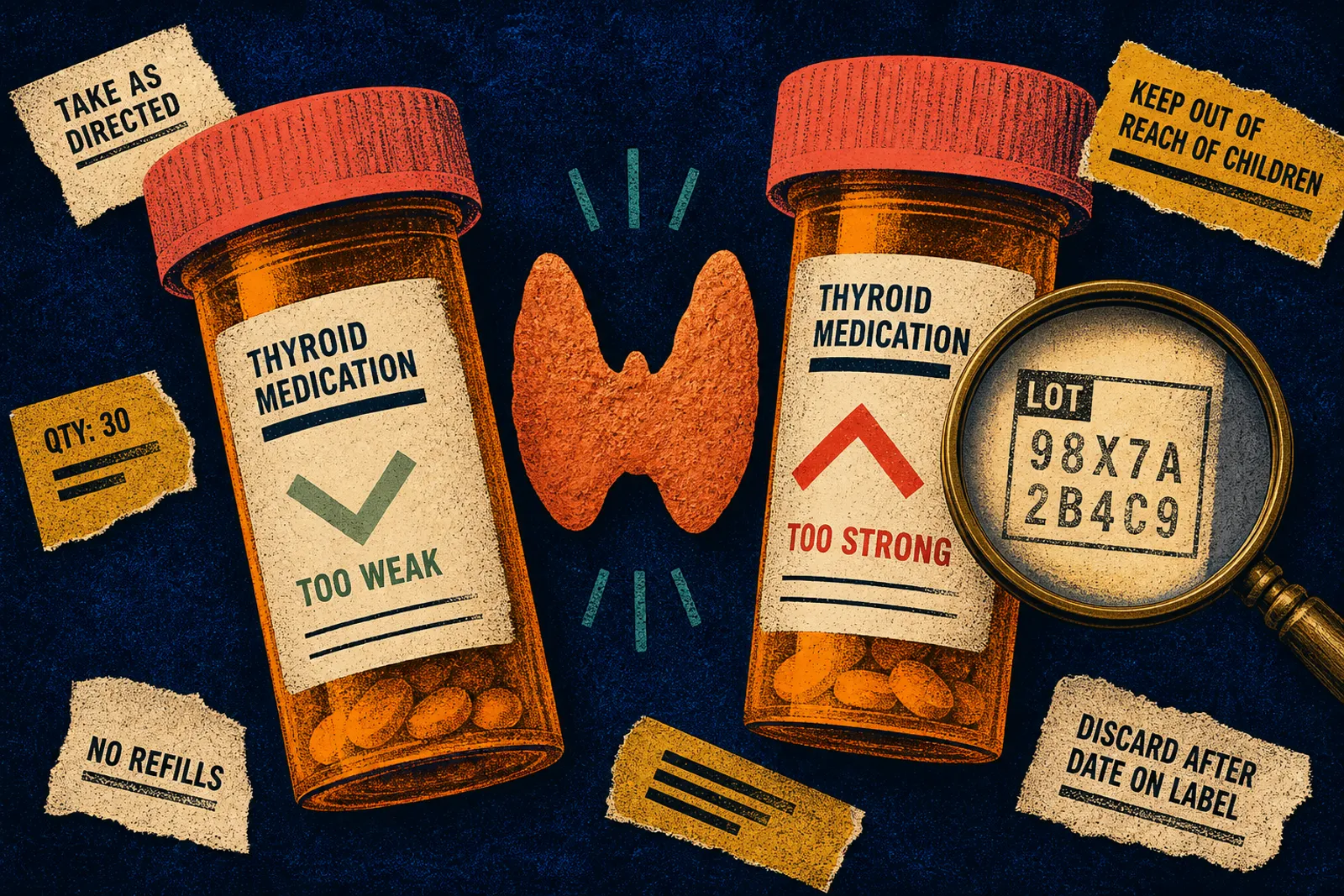
Same gland. Opposite math.
Too little hormone: Accord Healthcare (Raleigh, N.C.) recalled levothyroxine sodium tablets made by Intas Pharmaceuticals in Selaqui, Dehradun, India. The firm started the action on Aug. 6. FDA later tagged it Class II — temporary or medically reversible harm possible; serious harm remote — and the classified entries hit consumer coverage this week. Reason on the reports: subpotent drug, meaning assay came in below the allowed range. Epoch Times’ Aug. 27 wrap walked the 25–100 mcg lots in the files; MedShadow’s recall desk said the same classified wave also covers other bottle counts and strengths up to 300 mcg. Treat any table as a starter. Search IRES yourself.
Too much hormone: Vitruvias Therapeutics (Auburn, Ala.) voluntarily recalled one lot of Thyroid Tablets, USP 30 mg — desiccated (animal-derived) thyroid, not the synthetic T4 in Accord’s bottles — after testing found a risk the tablets were superpotent. Company date: Aug. 21. FDA posted the company announcement Aug. 24; USA TODAY updated Aug. 26. About 3,655 units released, 1,955 sold, shipped to direct accounts Jan. 31–Sept. 30, 2025, with an expiration still in front of you: Sept. 30, 2026. No adverse events tied to the lot, the company said. Superpotent thyroid can push people toward hyperthyroid symptoms — palpitations, heat intolerance, weight drop, blood-pressure spikes — and the firm flagged extra risk for older adults, pregnancy, and infants. Fox Business and Medical Daily both reprint the NDC/lot block.
If your bottle is a different manufacturer, a different NDC, or a different lot, it is not in these two actions. Thyroid fills get substituted often. Check the label, not the brand you remember from 2019.
How to read the bottle in three minutes
- Drug name. “Levothyroxine sodium” is the synthetic T4 (generic for Synthroid and peers). “Thyroid Tablets, USP” or “desiccated thyroid” is the pork-gland product. They are not interchangeable in a recall search.
- NDC. Three-segment number, often on the manufacturer stock bottle and sometimes on the pharmacy label. Accord lots in this week’s wrap sit in the 16729- family. Vitruvias 30 mg is 69680-166-00.
- Lot / batch. Look for “Lot,” “Lot #,” or “Batch.” If the pharmacy poured into a vial, that number may live only in the fill record. Call and read your Rx number. Do not guess from the expiration date alone.
- Manufacturer line. “Manufactured for Accord Healthcare” / “Intas” vs “Vitruvias.” Mail-order and big-chain labels bury this in small type.
- Count. Accord’s classified lots include 90-count and 1,000-count stock bottles. Your amber vial of 30 or 90 is often a split from a bigger bottle — another reason the pharmacy computer matters more than the sticker.
Same lookup pattern as other consumer pulls we have walked — lot on the package, then a call, not a social-media rumor. See the freezer-box method in our Outshine fruit bars recall note and the VIN/software path in the Toyota Camry/Tacoma recall. Drugs add one extra step: the dispenser, not the original pack, is often what you hold.
Accord levothyroxine lots that made this week’s report
These are the Accord/Intas 25–100 mcg lots listed in the Aug. 27 enforcement-report coverage. Confirm against IRES before you act — FDA rows get corrected, and MedShadow’s read of the same files includes additional strengths.
| Strength | NDC (as reported) | Recall No. | Lots / expirations (as reported) |
|---|---|---|---|
| 25 mcg | 16729-447-17 (1,000-count) | D-0775-2026 | D2401927, D2401833 (8/31/2026); D2402551, D2402552 (11/30/2026); D2500220 (12/31/2026); D2500223 (1/31/2027) |
| 50 mcg | 16729-448-17 (1,000-count) | D-0776-2026 | D2401834, D2401982 (8/31/2026); D2402584–D2402589 (11/30/2026) |
| 75 mcg | 16729-449-17 (1,000-count) | D-0777-2026 | D2402016, D2402017 (8/31/2026) |
| 88 mcg | 16729-450-17 (1,000-count) | D-0778-2026 | D2401813, D2401814 (8/31/2026); D2500200, D2500219 (12/31/2026) |
| 100 mcg | 16729-451-15 (90-count); 16729-451-17 (1,000-count) | D-0779-2026 | 90-count: D2402186 (9/30/2026). 1,000-count: D2402019 (8/31/2026); D2402094 (9/30/2026); D2500021, D2500022, D2500023 (12/31/2026) |
Class II is not “ignore it.” Thyroid hormone has a narrow therapeutic window. A few percent under label, taken daily for months, shows up as TSH drift, fatigue, cold intolerance, weight creep — the same symptoms people already blame on “my thyroid acting up.” NIDDK’s hypothyroidism explainer is the baseline disease page; MedlinePlus on levothyroxine is the drug page. Neither replaces a TSH/free T4 draw if your numbers have wandered.
Accord and Intas have been down this road. MedShadow notes prior Accord levothyroxine pulls in June 2025, September 2025, and July 2026, plus an FDA warning letter dated March 30, 2026, after a September 2025 inspection at the Selaqui plant — out-of-spec stability, including subpotent assays that kept showing up after corrective actions. That letter is the manufacturing backdrop, not a separate consumer recall of every Intas tablet in the country.
Vitruvias 30 mg lot 504950
One lot. Consumer level. Easy to over-read as “all natural thyroid is recalled.” It is not.
- Product: Thyroid Tablets, USP 30 mg
- NDC: 69680-166-00
- Lot: 504950
- Expiration: 9/30/2026
- Why: potential superpotency (more hormone than the label)
Good Housekeeping’s consumer write-up stresses the same instruction the company put in the FDA notice: if you are on lot 504950, call the prescriber before you dump the bottle in the trash and skip doses. Abruptly stopping thyroid replacement is its own problem. Excess hormone is the other.
Desiccated thyroid is a different regulatory animal from FDA-approved levothyroxine tablets. MedShadow flags that these animal-derived products have not gone through modern FDA approval for safety, purity, and potency — a long-running agency concern, separate from this one lot. If you take “natural thyroid” because synthetic T4 “didn’t work,” this recall is a reminder that lot-to-lot assay is the whole game. Parallel lesson from another unapproved-or-compounded desk: our earlier compounded GLP-1 explainer is about a different molecule, same patient habit of assuming the label always matches the vial.
Do not stop cold
Thyroid hormone is not an antibiotic you can pause for a long weekend. A missed week can undo a dose titration that took months. The Vitruvias notice is explicit: patients on lot 504950 should not discontinue without contacting a healthcare provider for guidance or a replacement prescription. The Accord Class II action is a pharmacy/wholesaler problem first — many patients never see a manufacturer stock bottle — but the clinical rule is the same: replace, don’t ghost the drug.
Practical script for the phone:
- “I take [levothyroxine / desiccated thyroid] from your pharmacy. Can you check my last fill against Accord NDC 16729-… and Vitruvias lot 504950 / NDC 69680-166-00?”
- “If it matches, I need a replacement from a non-recalled lot today, and I need to know whether to finish the current vial or switch now.”
- “Please put a note on the profile so the next auto-refill doesn’t pull the same lot.”
If you are on Medicare and already staring at 2027 plan paperwork, keep the pharmacy conversation in the same folder as the annual notice — see our Medicare ANOC / open enrollment explainer. Formulary and mail-order vendor can change which generic you get in January. This week’s lots are a 2026 fill problem; January is a different manufacturer roll of the dice.
When to call the same day
Recall class is a population risk label. Your body is a single sample. Same-day clinician contact (or urgent care / ER if severe) is reasonable if you are on a matching lot and you have:
- Possible excess (Vitruvias direction): new racing heart, chest pain, tremor, insomnia, heat intolerance, marked weight loss, or pregnancy with those symptoms
- Possible deficit (Accord direction): sharp fatigue, swelling, confusion, very slow heart rate, or known heart disease with a sudden slide — especially if you already run on the edge of replacement
Chest pain and severe palpitations are not “wait for the pharmacist’s callback” events. The recall paperwork can wait in the lobby.
Why the pharmacy may not call you first
Drug recalls often start at wholesaler and pharmacy level. Class II levothyroxine actions in particular have a history of patients learning from the news, not a text. Pharmacies are not always required to ring every last fill. That is annoying. It is also how the system is built. You are the second auditor.
Mail-order 90-day bottles are the highest-stakes check: more days of a weak or strong lot, fewer trips past a counter where someone might notice. If the bottle is already in a monthly pill organizer, you still have the original vial in the cabinet — that is the lot source, not the organizer.
Fall shot season is a useful reminder to actually open the cabinet. If you are already scheduling a 2026–2027 flu vaccine visit, bring the thyroid bottle to the pharmacy window the same trip.
Why a thyroid medication recall week still matters
Potency failures on thyroid products are not a 2026 novelty. Levothyroxine is sensitive to heat, humidity, and process control; desiccated products add gland-source variability. What is new this week is the pairing: a high-volume generic running light in classified enforcement reports, and a smaller desiccated lot running heavy in a consumer-level pull, hitting the same search bar two days apart.
The thyroid medication recall job for a household is dull on purpose. Read NDC. Read lot. Call. Replace. Get labs if symptoms moved. Do not crowdsource a new dose on a forum because a headline said “thyroid pills recalled.” Most bottles in the United States are not in these lots. The ones that are should not be guessed from the color of the tablet.
Informational only — not medical advice. Confirm lot matches and replacement fills with a pharmacist or prescriber. Do not stop thyroid hormone without clinical guidance.