Key takeaways
- The United Arab Emirates imposed an indefinite UAE Iran trade embargo early Aug. 19, 2026: “All trade, commercial exchanges and financial transactions with Iran have been halted until further notice,” the Foreign Ministry said — after the Defence Ministry reported two ballistic missiles launched from Iran late Tuesday.
- Before the regional war, the UAE supplied more than 30% of Iran’s imports (~$21 billion per WTO 2024 figures) and took nearly 13% of Iran’s exports (~$7 billion). Dubai also functioned as a financial conduit around sanctions — cutting both goods and money flows hits harder than many U.S. tariff rounds.
- The embargo lands alongside a U.S. naval blockade on Iranian ports, IMF forecasts of ~70% inflation and 5.4% economic contraction in Iran, and renewed Hormuz shipping risk after ADNOC tanker attacks. Iran called the missile story a false flag and denied launching at the UAE.
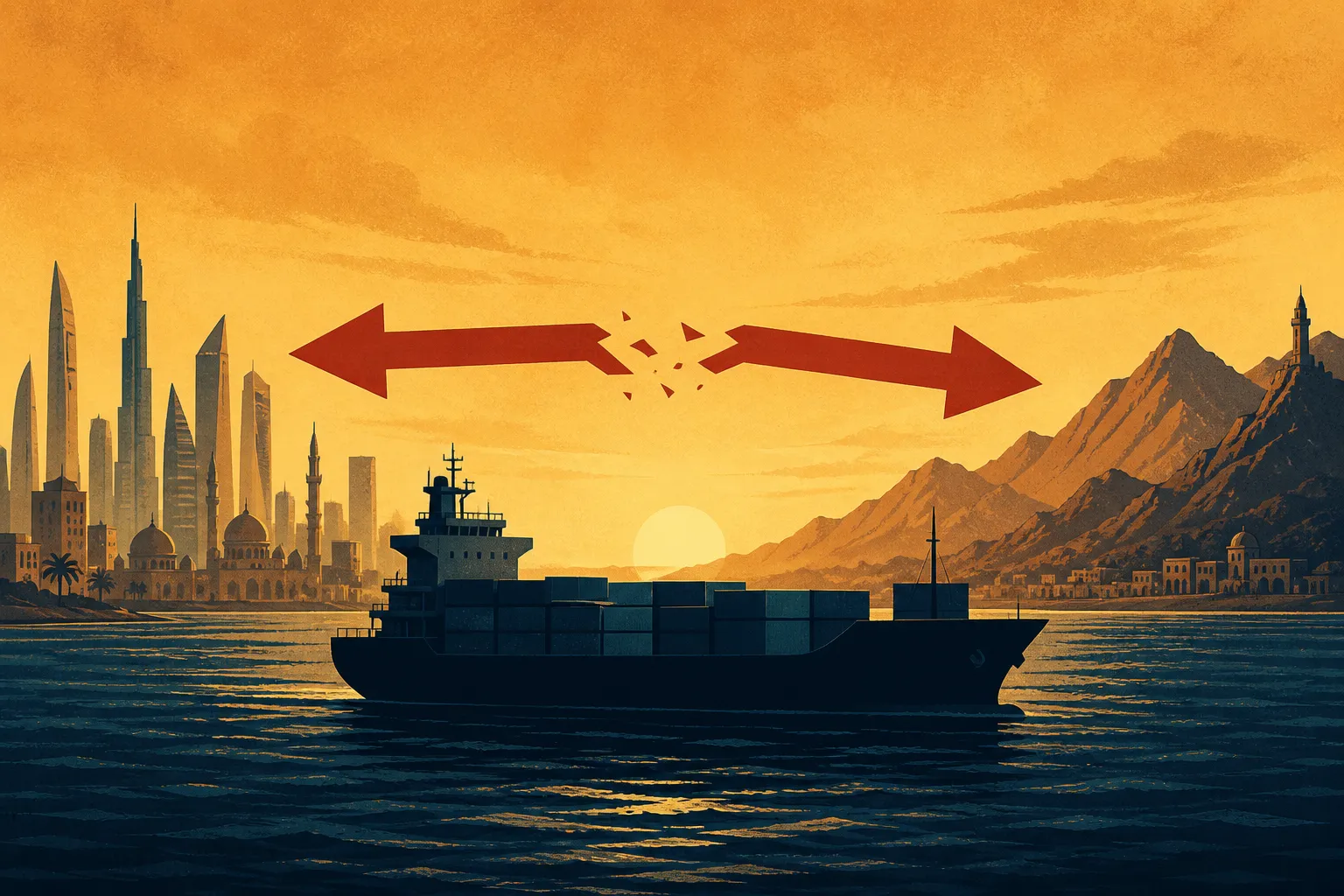
The UAE Iran trade embargo is not a symbolic diplomatic freeze. When Abu Dhabi halts all commercial and financial exchange with Tehran, it closes the Gulf’s busiest re-export lane for a country already under U.S. port blockade and record rial weakness. Aug. 19 headlines focus on missiles; the economic lever may outlast the air-defence alert.
What the UAE announced Aug. 19
The UAE Ministry of Foreign Affairs issued a statement early Wednesday citing “regional escalations that undermine regional and international peace and security.” Core language:
All trade, commercial exchanges and financial transactions with Iran have been halted until further notice.
The ministry paired the punitive measure with rhetoric about remaining committed to “dialogue, cooperation and regional integration” — standard Gulf diplo-speak when security and commerce diverge. There is no published sunset date; “until further notice” means indefinite.
Reporting: Al Jazeera on the embargo announcement, The Independent on UAE suspension.
The alleged Aug. 18 missile launches
The UAE Ministry of Defence said air defences detected two ballistic missiles launched from Iran late Tuesday. One fell outside UAE territorial waters; one landed within them — both splashed down in the Persian Gulf without casualties reported in initial wire copy.
The interior ministry sent phone alerts to residents: first a missile-threat warning, then an all-clear saying the situation was safe and normal activity could resume. The sequence — alert, splashdown, trade embargo — unfolded within hours.
This is the first reported ballistic missile targeting of the UAE since a May 4 strike on Fujairah port. In the war’s first six weeks, Iran launched 530+ ballistic missiles, dozens of cruise missiles, and 2,200+ drones at Gulf targets it described as U.S. assets — the UAE absorbed more retaliatory fire than any other Gulf state in that window.
Why the UAE Iran trade embargo matters economically
Iran has survived decades of U.S. sanctions partly because neighbors kept informal lanes open. The UAE — especially Dubai and Jebel Ali Port — was the largest piece of that puzzle: consumer goods, industrial inputs, re-exports, and discreet financial flows.
Analysts quoted by Al Jazeera said the move could hurt Iran more than many prior U.S. sanctions because it removes both the goods pipe and the money pipe. Treasury Secretary Scott Bessent had said economic isolation on Iran had “never been higher” even before Abu Dhabi acted; the UAE step adds a regional enforcement layer Washington cannot replicate alone.
For the UAE itself, the calculus is risk management. As a tourism and finance hub, prolonged conflict with Iran threatens non-oil GDP. The embargo is punitive toward Tehran but also defensive — signaling that missile splashdowns near Dubai have a trade cost.
Pre-war trade numbers — WTO baseline
World Trade Organization figures cited across Aug. 19 coverage (2024 data):
- UAE share of Iran imports: more than 30%, valued near $21 billion
- UAE share of Iran exports: nearly 13%, near $7 billion
Trade did not run smoothly through the war. The UAE suspended direct cargo shipping in early March 2026, days after fighting began, then resumed limited flows in late June via Jebel Ali. Aug. 19 closes that reopened lane entirely.
Strait of Hormuz and ADNOC vessel attacks
Days before the embargo, Abu Dhabi accused Iran of attacking two ADNOC (Abu Dhabi National Oil Company) vessels transiting the Strait of Hormuz. Hormuz handles roughly one-fifth of global oil transit in normal years — any sustained closure reprices Brent crude and downstream diesel at the pump.
President Trump said last week the strait was open; Iran maintains it remains shut to shipping. Reality sits between headlines — insurers raise war-risk premiums, vessels delay, and floating storage builds regardless of which capital claims victory.
A 60-day U.S.–Iran peace-talk window expired Monday without breakthrough, raising fear of renewed escalation after five months of conflict disrupting Gulf shipping since February.
Iran’s denial and the false-flag claim
Iran denied firing the Tuesday missiles. State media called the reported attack a false flag operation by Israel and the United States — a predictable response that still leaves UAE policy unchanged. Mohammad Mokhber, adviser to Iran’s supreme leader, said Tehran remains open to dialogue with Washington but “does not confuse negotiations with surrender,” per Fars news agency.
Markets price actions, not press releases. Whether the splashdown was Iranian origin, misidentified debris, or something else, Abu Dhabi has chosen economic severance as the response.
U.S. blockade and Bessent’s isolation push
The UAE Iran trade embargo stacks on a U.S. naval blockade of Iranian ports — part of a Trump administration pivot toward economic pressure over additional military strikes, per reporting on Aug. 19. Bessent previewed combined isolation and blockade measures; bombing campaigns have already hit industrial and civilian infrastructure inside Iran.
IMF projections in circulation: ~70% inflation in Iran this year and 5.4% GDP contraction, with the rial at record lows. Closing the UAE corridor accelerates import scarcity on top of currency collapse — food, medicine, and spare parts are the humanitarian pressure points watchers flag even when headlines stay geopolitical.
Oil, diesel, and what traders price next
Equity indexes may shrug; energy markets do not. The embargo itself is bilateral trade, not an OPEC production cut — but Hormuz risk, ADNOC vessel attacks, and Iranian retaliation options feed the same risk premium that kept Brent above $90 while EIA averages lagged lower in August forecasts.
Watchlist for the next week:
- Jebel Ali and Dubai re-export flows — confirmation that transshipment to Iran is fully blocked, not partially enforced
- Insurance and freight quotes through Hormuz — leading indicator before spot crude moves
- UAE–Iran diplomatic back channels — Gulf states have reversed trade freezes before when de-escalation served both sides
- U.S. secondary sanctions — whether Washington formalizes the UAE move in Treasury guidance
The UAE Iran trade embargo turns a neighbor that was Iran’s economic back door into a locked gate. Indefinite duration, no published exemption list, and missile alerts on residents’ phones — that is the Aug. 19 story traders and diplomats will track into the weekend.
News analysis only. Sanctions, shipping, and conflict status change rapidly. Confirm current government and market data before business or travel decisions. Not legal or investment advice.