Key takeaways
- SNDK is Sandisk Corporation, Nasdaq-listed after the Feb. 21, 2025 separation from Western Digital. It is NAND and SSD, not HDD. WDC kept the drives that spin.
- Fiscal Q4 ended July 3, 2026: $8.97 billion revenue (+51% sequential, +372% year over year), 84.6% gross margin, GAAP EPS $43.97. About two-thirds of the sequential revenue lift was price. Datacenter $2.98 billion, doubled quarter on quarter.
- Q1 FY2027 guide is $10.30–$10.80 billion and $44–$46 non-GAAP EPS. That beat a lot of models from a year ago and still disappointed a tape that had already paid for a NAND supercycle. Reuters had the stock down about 13% the next session.
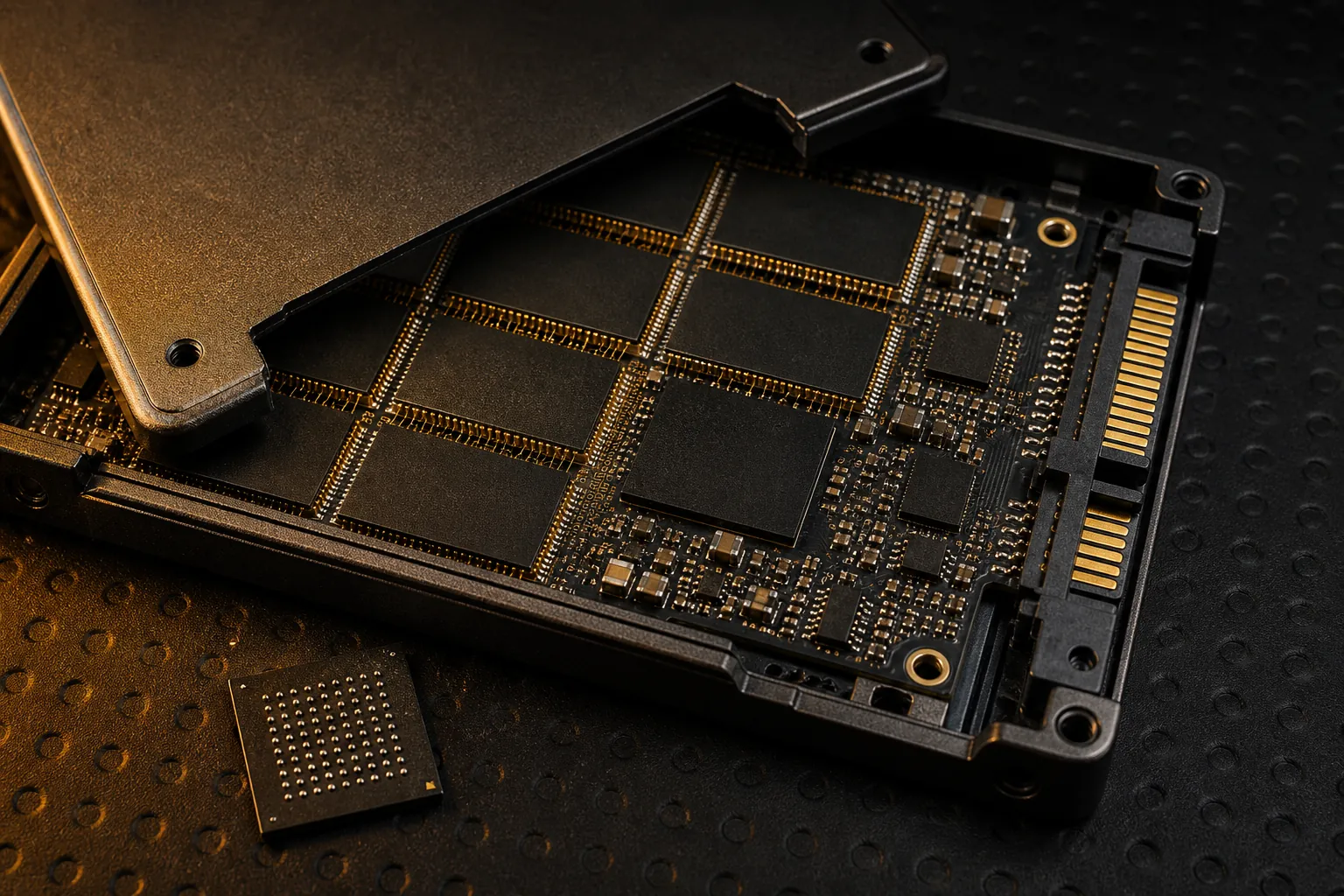
SNDK is not a ticker looking for a company. It is Sandisk, the flash business Western Digital carved out and listed on Nasdaq on Feb. 21, 2025. The consumer brand on the USB stick is the same lineage. The income statement in 2026 is a different animal: datacenter SSDs, edge (phone and PC NAND), a Kioxia joint venture in Japan, and a long-term contract layer management calls NBM. If you still think “SanDisk = SD cards at Best Buy,” you are reading last decade’s 10-K.
The Aug. 5 print was a record. The Aug. 6 tape treated it as a miss. Both can be true when two-thirds of growth is price and the next guide is a few hundred million light of what a $1,000-plus multiple had underwritten.
What SNDK is
Western Digital spent years as a two-headed storage company: hard disk drives and NAND flash (the old SanDisk plus the Kioxia JV). The board split them. HDD stayed WDC. Flash became Sandisk (they dropped the internal capital D in the IR styling). David Goeckeler is chairman and CEO of SNDK. Pre-separation numbers in the filings are carve-outs from WDC. Post-Feb. 21, 2025 they are a real standalone consolidating entity. Compare FY2025 and FY2026 with that in mind.
What they sell: 3D NAND (BiCS, designed and made with Kioxia), SSDs, embedded, cards, USB, wafers and components. Vertically integrated on design and a lot of manufacturing, not a fabless GPU company. That is why capex as a percent of sales still matters, even when they are returning cash.
The Q4 print
Fiscal fourth quarter ended July 3, 2026. Source: Sandisk Q4 FY2026 release and the Aug. 5 8-K.
- Revenue $8.965 billion. Sequential +51%. Year over year +372% versus $1.901 billion in Q4 FY2025.
- Gross margin 84.6% (GAAP and non-GAAP in the table), versus 78.4% in Q3 and ~26% a year earlier.
- GAAP net income $6.90 billion, $43.97 per diluted share. Non-GAAP EPS $39.25.
- Datacenter $2.977 billion (+103% sequential). Edge $5.432 billion (+48%). Consumer $556 million (−32% sequential).
- Full year FY2026: $20.25 billion revenue (+175%), GAAP EPS $73.76, non-GAAP $70.88. Datacenter for the year $5.15 billion (+437%).
On the call, management said datacenter had gone from about 12% of the bit mix at the start of the year to 38%. Edge is still the bigger dollar bucket in Q4. Consumer got rationed: when NAND is on allocation, you do not feed the USB channel first.
Q1 FY2027 outlook: revenue $10.30–$10.80 billion, non-GAAP gross margin 83–85%, non-GAAP EPS $44–$46, ~155 million diluted shares. They bought back 2.84 million shares in Q4 for $4.5 billion. Board added a $14 billion authorization; remaining authorization $15.5 billion. Authorization is a ceiling. We already covered that plumbing: stock buybacks.
Price, not just bits
The sentence that matters is in the release: sequential revenue growth was about one-third volume, two-thirds price. Bit growth for FY2026 was mid-teens. The rest of the 175% year-over-year revenue jump is mix and ASP. That is a NAND upcycle, not a software company discovering a new product.
NAND does this. Oversupply in 2023–2024 smashed prices and WDC’s flash P&L. Undersupply plus AI inference SSDs (capacity, QLC “data lake” drives, KV-cache adjacent workloads) sends ASPs vertical. Sandisk’s own TAM talk on the call: NAND market over $300 billion in calendar 2026, approaching $500 billion in 2027; datacenter’s share of NAND TAM from ~30% in 2025 toward ~50% in 2026; bits on allocation past 2027. Those are management forecasts, not a census. Price is also why consumer revenue fell 32% in a quarter when the company is “winning.” Units in PCs and phones were described as mid-teens down for the calendar year. High NAND cost kills retail kits.
84% gross margin is operating leverage on a shortage. The same leverage runs backward when three Korean/Japanese/U.S. suppliers add bits at once. That is the cyclical risk. It is not a footnote.
The NBM contracts
New Business Model is Sandisk-speak for multi-year supply deals with floors, deposits, and sometimes third-party guarantees — closer to HBM-style offtake than to spot NAND. On the Q4 call they cited eight NBMs, a minimum $93.9 billion of future revenue at floor pricing, remaining performance obligation $91.1 billion (including two deals signed after quarter-end), and $16.5 billion of financial guarantees. NBM bits: more than half of FY2027, about two-thirds in FY2028, per CFO Luis Visoso.
That is how you try to keep an 80% margin from becoming a 30% margin in 18 months. You also lock mix. You hold more inventory to service the contracts, which they said cuts sellable bits in FY2027. You take customer-default and take-or-pay legal risk. The 10-K will be more useful than the acronym.
Kioxia and BiCS
Almost all of Sandisk’s NAND still comes through the decades-old joint venture with Kioxia (Tokyo: 285A), Yokkaichi and Kitakami. In January 2026 they extended Yokkaichi (and aligned Kitakami) through Dec. 31, 2034. July 2, 2026: production of 10th-generation 3D flash started at Kitakami Fab2. JV extension. Kitakami BiCS10 start.
BiCS8 is already the majority of their bit output, with CMOS bonded to the array (CBA). QLC “Stargate” started shipping for revenue in Q4 — high-capacity, AI data-lake class, not a client SSD you drop in a laptop. Partner and competitor are the same Japanese name. Kioxia sells too. Capacity additions are a JV decision, not a Sandisk-only slide.
This is a different chokepoint than TSMC CoWoS on the GPU side of the same AI build. NAND is bits and price. GPUs are packages and HBM. The stack piece: AI semiconductor and optical stocks.
HBF is not HBM
High Bandwidth Memory is DRAM stacked next to the GPU. High Bandwidth Flash is NAND aiming at a slot closer to the accelerator for inference working sets that are huge and do not need DRAM’s latency everywhere. Sandisk and SK hynix put the first HBF technical spec through the Open Compute Project on Aug. 3, 2026 — six months after the workstream started. Google and Tenstorrent joined the consortium. The spec is a framework (interface, stack, software guide), not a SKU with a shipping date on the earnings call. Goeckeler pointed to Analyst Day for product timing. Source: Sandisk / SK hynix HBF OCP spec.
Do not put HBF revenue in FY2027 EPS. Do put it in the reason the multiple exists: if inference wants a cheaper, denser near-compute tier, NAND vendors get a second product cycle after SSDs. If HBM stays good enough, HBF is a conference badge.
Why the stock dropped
Reuters, Aug. 6: SNDK about −13%, WDC about −19%, Seagate and the memory complex lower with them. The guide ($10.3–$10.8 billion) cleared some sell-side numbers and sat under the “whisper” that a year-to-date melt-up had baked in. Two-thirds price is also two-thirds of why bulls were there. When the sequential ASP step looks smaller than last quarter’s, the duration of the shortage is the debate, not whether Q4 happened.
A $14 billion buyback on a company that just generated multi-billion operating cash flow is management saying the windfall is real and they will not dump all of it into a new fab tomorrow. Capex was described around 6% of sales, targeting ~6% in FY2027 even as BiCS8/BiCS10 spend continues. That is a high-margin NAND print, not a foundry build cycle.
What to read next, not a shopping list: the Q1 guide versus actual ASP commentary; NBM share of bits; whether consumer stays starved; whether HBF is still “spec” at Analyst Day; Kioxia’s own production comments. SNDK and WDC can diverge. One sells flash into AI servers. One still sells spinning rust into the same buildings. They are no longer the same 10-K.
Education, not a recommendation to buy or sell SNDK, WDC, Kioxia, or SK hynix. Figures from Sandisk’s Aug. 5, 2026 release, 8-K, and company press releases. NAND prices move. Read the 10-K when it files.