Key takeaways
- The Microsoft 365 outage Microsoft dated as starting Monday, Aug. 31, 2026, at 3:08 p.m. UTC (11:08 a.m. ET) is an authentication-configuration failure, not a regional fiber cut. Microsoft’s own line, copied into tenant alerts: “An issue within a core authentication configuration used by multiple Microsoft 365 services is resulting in impact.” Live tape: BleepingComputer’s incident log and Mashable’s spokesperson quote.
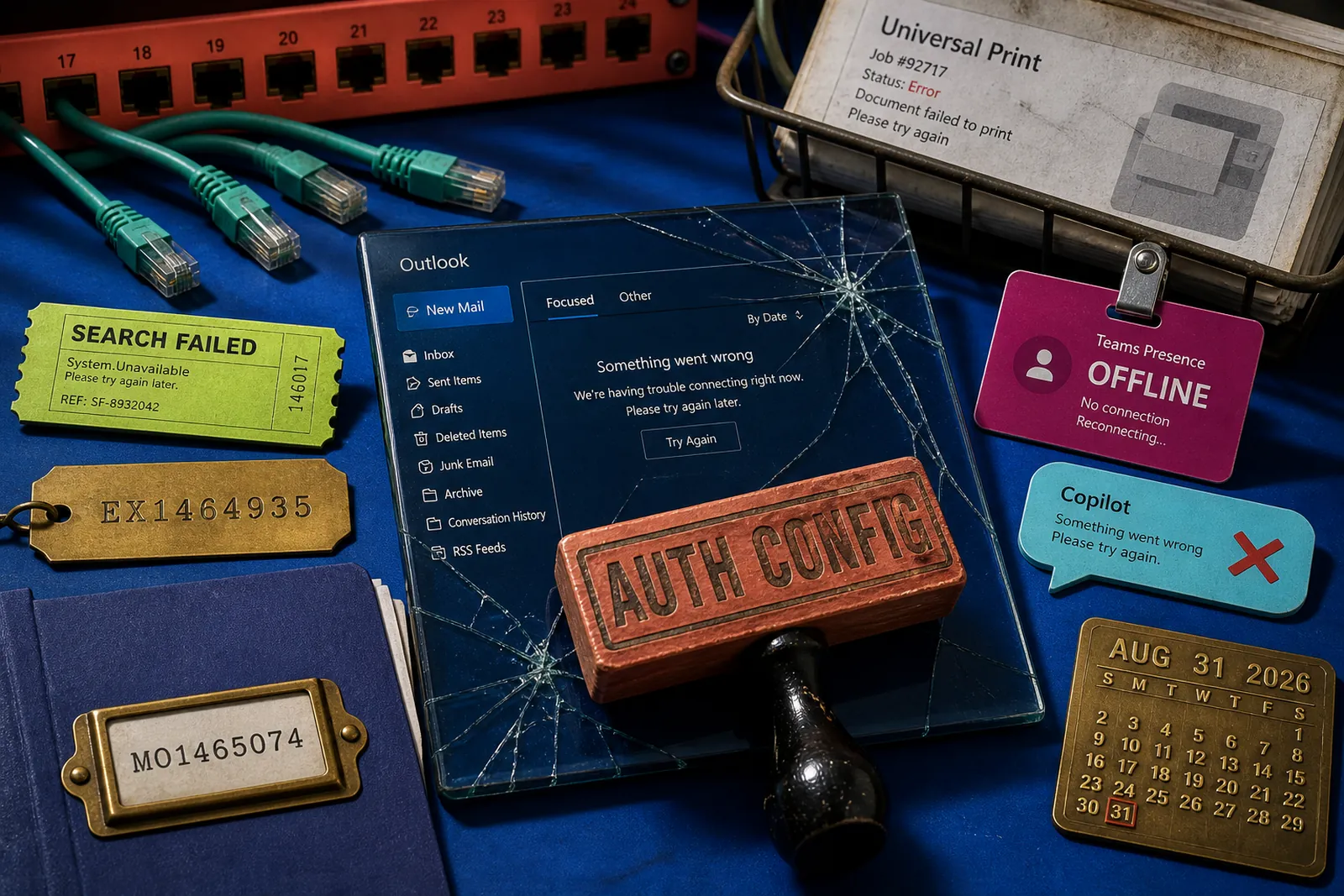
- Admins should keep two tickets in the same folder. EX1464935 is Exchange Online — Microsoft kept it open because mail was the loudest desk. MO1465074 is the suite wrap: OneDrive, SharePoint, Teams, Purview, Defender XDR, Admin Center, Copilot prompts that need Microsoft 365 grounding, Universal Print. Penn’s public dump of the Exchange post is here. NHS England’s tenant copy of the suite list is here.
- By Tuesday 12:00 UTC, Microsoft said core Exchange Online mail flow and search had recovered and that it was validating leftover pockets on the rest of the suite. Search had been the lagging part overnight — Computerworld’s Tuesday wrap. A separate Copilot volume incident (2:23–4:05 p.m. UTC Tuesday) is not MO1465074. Do not mash them.
Monday was not “Outlook is slow.” It was the shared login bolt on the suite. Mail, calendar, Teams presence, OneDrive search, Copilot prompts that read your inbox, print jobs, even the admin center that is supposed to tell you what is broken — they sit on the same authentication configuration. When that configuration failed, the apps did not all go black. They failed in pieces: send delayed, search empty, presence stuck, Copilot answering with nothing from the tenant. Tuesday is the aftertaste. Mail came back first. Search lagged. The Microsoft 365 outage is still a validation story until your own tenant’s Service Health row goes green, not until a public dashboard looks quiet.
Mode: rotate · Category: Apps (Technology)
What Monday actually logged
Microsoft’s start stamp, in the Exchange post, is Monday, August 31, 2026, at 3:08 p.m. UTC. Computerworld, working from the University of Pennsylvania IT dump of the admin console, puts the investigation earlier: user-report volume on Exchange Online at 11:55 a.m. UTC, a common failure pattern on authentication and protocol connectivity isolated by 12:33 p.m. UTC, then the official broader start a few minutes after 3:08 p.m. UTC. Those clocks can sit together. 11:55 is when the queue lit up. 15:08 is when Microsoft was willing to date the incident.
BleepingComputer’s first public acknowledgment is later still — 5:30 p.m. UTC on the original Exchange ticket, then a retitle when the suite ticket existed. Mashable has the consumer timestamp: Microsoft’s status account posted at 12:01 p.m. ET, and a spokesperson emailed, “We’re aware of an issue affecting access to Exchange Online and some other services. We know this is disruptive for customers and we appreciate their patience while we work to restore services as quickly as possible.” That sentence does not name a region. Microsoft still has not published a country list. Treat it as global until a tenant post says otherwise.
BleepingComputer, citing Downdetector, put “tens of thousands” of Outlook and Microsoft 365 reporters on the board Monday. That is a complaint counter, not a seat-license census. Do not convert it into “X percent of Exchange.” The useful number is the one on your own Message trace and Teams call-quality dashboard, not someone else’s heatmap.
This sits on the Apps desk because the objects people touched were Outlook, Teams, OneDrive, SharePoint in the browser, Copilot in the same chrome, and the admin center those apps report into. It is not a chip story. It is not a consumer Windows Update. It is the suite of apps a company pays for by the seat, failing on a shared auth part.
Two IDs, one till: EX1464935 and MO1465074
Microsoft split the paperwork. Keep the labels.
| ID | What it is | Why it exists |
|---|---|---|
| EX1464935 | Exchange Online incident. Sign-in / mailbox access feature group. Classification: incident. | Mail was the first and loudest failure. Microsoft said it kept this post open because Exchange remained “the most predominantly impacted service.” |
| MO1465074 | Microsoft 365 suite incident. The wrap for everything that shares the auth config. | Opened once Microsoft confirmed the same component was hitting OneDrive, SharePoint, Teams, Purview, Defender XDR, and the rest. |
If you only watch EX1464935, you will think this is an email outage with a search hangover. If you only watch a public “all operational” tile, you will miss residual search and Copilot grounding. The admin-center how-to is Microsoft’s own: View the health of your Microsoft services. That page is the live door. A screenshot on X is not.
Penn’s Exchange dump is useful because it reprints Microsoft’s symptom list without a press-office rewrite: delays or failures sending and receiving; incomplete mailbox search; authentication errors; admin-center trouble; intermittent mailbox operations; Outlook for iOS and Android send/receive failures. NHS.net’s MO1465074 copy is the suite list in the same voice. Use both. They are tenant-facing Microsoft text, not a recap blog.
The blast list: not just Outlook
Microsoft’s suite post, as NHS reprinted it Tuesday morning while the event was still marked ONGOING, is the inventory. Read it as “these apps share the bolt,” not “every tenant lost every row.”
| App / surface | What Microsoft said could fail |
|---|---|
| Exchange Online | Connect, search, send/receive, all connection methods. Mail was the headline. Search was the hangover. |
| Outlook for iOS and Android | Send/receive delays or failures — called out separately in the Exchange post. |
| OneDrive for Business / SharePoint Online | Account and storage tiles, search, Favorites, Followed, Shared With Me, recents, lists, news. File open delays, sync, camera upload, video playback. Partial page failures and retries rather than a blank slab. |
| Microsoft Teams | Calendar, search, stale presence (auto or manual), location updates. Teams Rooms and desktop phones showing offline in the admin center. |
| Microsoft 365 Copilot | Prompts that need Microsoft 365 grounding — email content, tenant files — may fail. That is Copilot-with-your-mailbox, not a model outage at the frontier API. |
| Microsoft Purview | Intermittent authorization. Admins locked out of the portal. Communication Compliance and DLP policy load/create/evaluate delays. |
| Microsoft Defender XDR | Intermittent authorization across solutions. |
| Microsoft 365 Admin Center | Admins may fail to authenticate into the place that is supposed to explain the outage. That is the cruel joke of the file. |
| Universal Print | Create, upload, or retrieve print jobs. |
Mashable’s Monday status-page list matches the first seven of those (OneDrive, SharePoint, Exchange, Teams, Purview, Defender XDR, Admin Center). Universal Print and the Copilot-grounding line are in the NHS suite copy. If your print queue died and your inbox looked fine, you were still in MO1465074. If Copilot would chat but would not cite last week’s mail, you were in MO1465074. If Copilot would not complete any prompt on Tuesday afternoon, that is the other ticket — see below.
Auth config is the shared bolt
Microsoft’s root-cause sentence did not change from Monday afternoon through Tuesday’s 12:00 UTC Exchange update: an issue inside a core authentication configuration used by multiple Microsoft 365 services. Earlier Monday, on the Exchange-only pass, it had been narrower — “a core authentication configuration used by multiple internal services within the Exchange Online infrastructure,” with engineers doing manual per-server resets to see if a config restore cleared it. Then the blast radius escaped Exchange, and the sentence widened to “multiple Microsoft 365 services.”
Computerworld’s timeline is the engineering afternoon: a potential corrective action identified around 13:30 UTC; nature of deployment still being evaluated; by 15:08 UTC the suite incident is on the clock; then hours of testing why the authentication components were not landing as expected, including a look at recent changes and a possible revert of an update on the affected kit. Mitigation testing turned positive around 17:55 UTC. Targeted re-apply of core auth components on a sample of infrastructure started about 18:40 UTC, then expanded, then came the restarts.
That is a config roll, not a DDoS press line and not a “the internet is down” story. Shared auth is why search, presence, and Copilot grounding can stay sick after SMTP is moving again. Mail flow is a pipeline. Search indexes and Copilot grounding are authenticated reads against the same tenant graph. Fix the bolt, wait for the reads.
Microsoft has had Exchange weather this year. BleepingComputer notes a June mail-flow pipeline incident across North America, APAC, and Europe, and April mailbox-access trouble on Outlook mobile and macOS. Those are adjacent files. They are not Monday’s auth config. Do not file “Exchange again” and stop. Monday’s object is the configuration several apps import.
Mail came back. Search did not, not at first.
Overnight is the split that makes this a Tuesday story rather than a Monday recap.
| Clock (from Microsoft posts / press wraps) | What was true |
|---|---|
| Mon ~10:01 p.m. ET | Mashable: recovery ongoing. Email delivery should return gradually. Search still impacted. Some infrastructure “not accepting the re-applied authentication components as readily as expected.” |
| Mon 11:52 p.m. ET | Mashable: mailbox connectivity should be back to normal. Search still being worked. Backlogged mail queues may take time to drain. |
| Tue 1:01 a.m. UTC | Penn dump: persistent recovery of mail flow validated. Focus shifted to search. |
| Tue 2:39 a.m. UTC | Restarts plus re-applying the auth-component fix “yielded progress” on search telemetry in a sample of the environment. No full-recovery ETA. Computerworld’s Tuesday lede sits here: day two, search still the open item. |
| Tue 6:58 a.m. UTC | A “substantial portion” of the remediation deployment complete. Remaining orgs expected to recover as the wave reached their infrastructure. |
| Tue 10:18 a.m. UTC | Positive recovery trends. Validating auth, connectivity, and search. |
| Tue 12:00 p.m. UTC | Core Exchange Online mail flow and search “have recovered.” Focus shifted to validating remaining Microsoft 365 services and residual pockets. Next update by 5:00 p.m. UTC. Classification was still incident / service degradation on that stamp — recovered is a sentence, not a closed ticket. |
Read 12:00 UTC as “the Exchange desk says the two loud symptoms are back,” not “every SharePoint search and every Teams Room is green.” Microsoft’s own next clause was validation on the rest of the suite. NHS still had MO1465074 as ONGOING at 9:08 a.m. UK time, with engineers restarting kit to recover search. Those two posts are hours apart and both can be right: search was the lagging function, then Exchange search recovered, then the suite still needed a walk.
If a message you sent at 11 a.m. Monday arrived at 9 p.m., that is the queue drain Microsoft warned about. It is not a new outage. If mailbox search is empty for mail you can already open, that was the Tuesday morning condition. If it is still empty after Microsoft’s 12:00 UTC line, it is either a residual pocket or a client cache. Rebuild the Outlook search index before you open a Sev-1 with your reseller.
Tuesday’s Copilot hit is a different ticket
Do not hang every Copilot failure on MO1465074. Penn’s log, Tuesday afternoon, has a separate Microsoft 365 Copilot incident:
- Start: Tuesday, September 1, 2026, 2:23 p.m. UTC
- End: 4:05 p.m. UTC
- Root cause: elevated request volume overwhelmed infrastructure that processes Copilot requests — not the Monday auth config
- Surfaces: Microsoft 365 Copilot, Copilot Chat, Declarative Agents, Copilot for Education
- Fix: traffic shifted off the overloaded slice. Final update 12:34 p.m. local on Penn’s stamp; Microsoft says it is looking at why volume caused impact and at scaling so it does not recur
Monday’s Copilot symptom was grounding: the model is up, the tenant read is not, because auth to mail and files is sick. Tuesday afternoon’s symptom was completions themselves failing or delaying. Different till. If your Copilot window died after lunch Tuesday and your Outlook search was already fine, you were on the volume ticket. If Copilot was up but would not cite the Q3 deck in SharePoint on Monday night, you were on the Microsoft 365 outage auth ticket.
A third Copilot-adjacent advisory in the same Penn dump is even narrower: admins may see delays in Copilot usage-report data in the Microsoft 365 admin center, start Monday 4:00 p.m. UTC, because a reporting component was deprecated. That is a dashboard backlog. It is not mailbox search. It is not Chat. Next update on that one was slated Wednesday. Do not wait on a usage graph to decide whether mail is moving.
Agent products on this site are a different shelf. Meta’s Hatch agent does not share Microsoft’s auth config. A Copilot miss on Monday was a tenant-read miss, not a proof that “agents are down.”
What this file is not
It is not a consumer Outlook.com outage unless your tenant is the consumer SKU — Microsoft’s public status tile for this event was Microsoft 365 Business or Enterprise. Consumer families and students have a different health surface. Check the SKU on the invoice before you forward a Sev-1 to a home Gmail thread.
It is not a Windows 11 patch. It is not a Chrome extension kill. Yesterday’s browser file on this site is Chrome Manifest V2 — a different vendor, a different bolt. If Edge tabs loaded and Outlook in the browser did not, that is Microsoft 365, not the renderer.
It is not proof your tenant was breached. Auth-configuration failures produce the same login errors as a bad Conditional Access change you made at 2 a.m. That is why the first admin move is Service Health, not a password blast. If you flipped a named-location policy Monday afternoon and mail died at 15:08 UTC with the rest of the planet, you still check the incident IDs before you roll the policy back. Correlation is not causation; 15:08 UTC is a strong hint.
It is not the Apps-desk legal files from last week. The Apple Siri settlement is a claims window. Android Pulse is a system app people mistook for malware. The AT&T–Charter “fiber-powered” case is a brochure-versus-bill fight. Monday is none of those. Monday is the suite you already pay for, sharing a config, and failing in public.
Checklist if Outlook, Teams, or Copilot still feel wrong
- Open Service Health before you reboot a fleet. Look up EX1464935 and MO1465074 in the Microsoft 365 admin center. Microsoft’s walkthrough is View the health of your Microsoft services. If the admin center itself will not auth — that was on the blast list — use the public wraps: BleepingComputer, Computerworld, Penn’s Exchange dump, NHS’s suite copy.
- Split the symptoms. Mail not sending is Exchange. Mailbox search empty with mail already in the folder is the lag Microsoft spent Monday night on. Teams presence stuck is Teams. Copilot that will not cite mail is grounding. Copilot that will not complete at all Tuesday afternoon was the volume ticket. Mixing them is how you wait on a closed ID.
- Do not mass-reset passwords because login failed at 15:08 UTC Monday. That was the shared config. A password blast creates a help-desk outage on top of the vendor outage.
- Expect delayed mail from the queue. Microsoft warned that backlogged messages would dribble in after connectivity returned. A 10-hour-late invoice is not a second incident unless new mail is still failing now.
- Rebuild Outlook search locally if server search is green in Service Health and the desktop client still returns nothing. The index is yours. The auth config is Microsoft’s.
- Teams Rooms and desk phones that showed offline in the admin center were on the suite list. Re-check the room account after MO1465074 validates, before you RMA a panel.
- Print last. Universal Print create/upload/retrieve sat on the same auth bolt. A stuck job Monday is not a new toner emergency.
- Watch for the 5:00 p.m. UTC Tuesday Exchange update — Microsoft scheduled it after the 12:00 UTC “mail and search recovered” line — and for MO1465074 to move off ONGOING. A closed ticket is the all-clear. A quiet office is not.
The Microsoft 365 outage that started Monday at 15:08 UTC was a core authentication configuration several apps import, logged first as EX1464935 on Exchange and then as MO1465074 on the suite. Outlook, Teams, OneDrive, SharePoint, Copilot grounding, Purview, Defender, print, and the admin center itself sat in the blast. Mail connectivity recovered Monday night. Search lagged into Tuesday. By noon UTC Tuesday Microsoft said Exchange mail and search were back and that leftover suite pockets were the remaining walk. A separate Copilot volume incident Tuesday afternoon is a different row. Until your tenant’s Service Health says the IDs are closed, the honest label is “recovering,” not “never happened.”
Informational only — not IT, legal, or vendor-support advice. Confirm the live Microsoft 365 admin-center posts for EX1464935 and MO1465074, and your own message-trace and audit logs, before you change Conditional Access, passwords, or client fleets. This publication is not affiliated with Microsoft.