Key takeaways
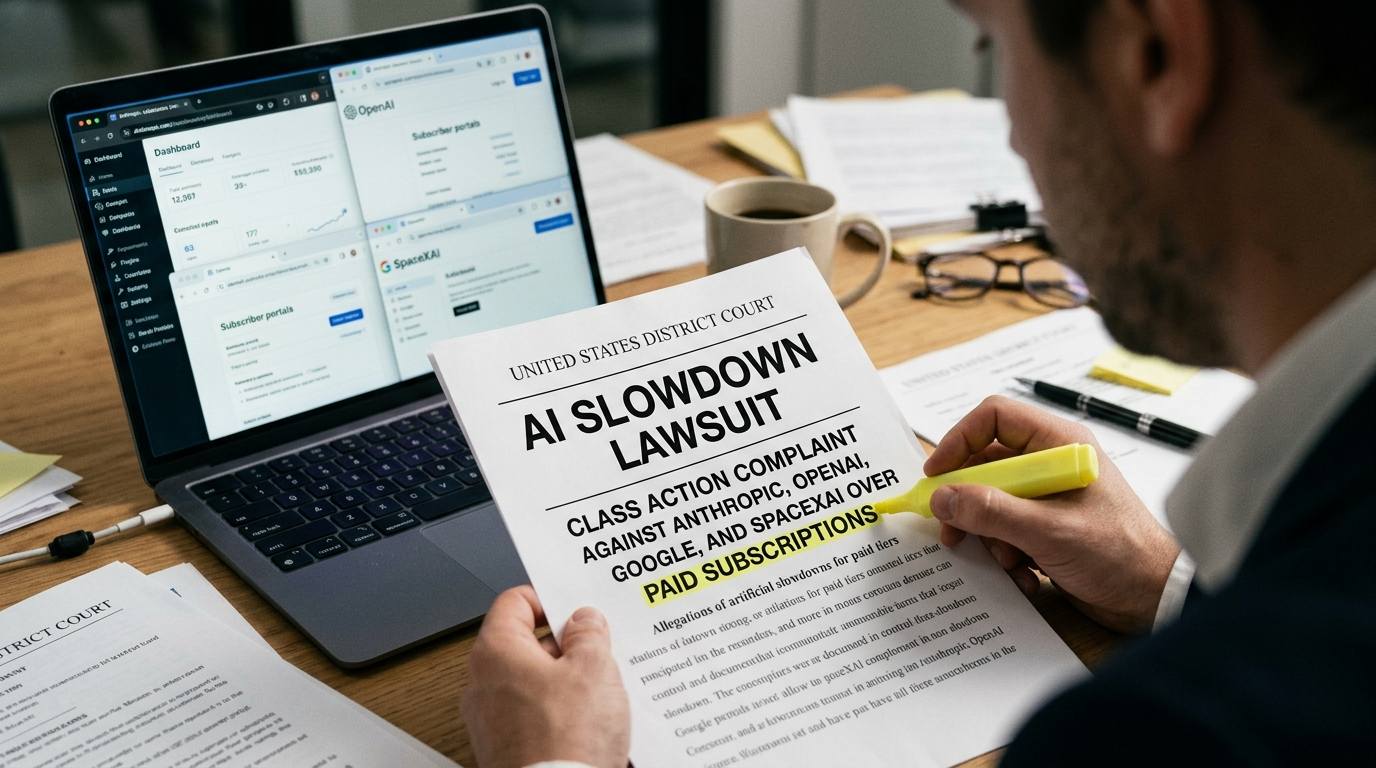
- Friday, Sept. 18: four paying subscribers filed an AI slowdown lawsuit in the U.S. District Court for the Northern District of California, San Francisco Division. The caption is Buist et al. v. Anthropic, PBC et al., No. 3:26-cv-10693. Defendants: Anthropic, OpenAI OpCo, SpaceXAI, and Google. Primary: the 29-page complaint (PDF). Same-day wrap: Forkast.
- The complaint treats Sept. 12 public statements as the agreement: Dario Amodei’s essay We Must Pace the Frontier, plus same-day replies it attributes to Elon Musk (“Dario is right”), Sam Altman, and Demis Hassabis. The proposed class is U.S. buyers of paid ChatGPT, Claude, Grok, or Gemini subscriptions from Sept. 12 through whenever the alleged effects stop.
- Two counts: Sherman Act §1 with treble damages under Clayton Act §4, and an injunction under Clayton Act §16. The complaint names no dollar figure for damages. Fortune, Saturday 4:34 p.m. ET, said the four companies had not commented.
Saturday’s Fortune note is the first full weekend recap of Friday’s filing. The essay the complaint quotes is a week older; this site’s file on that text is Pace the Frontier.
What Friday’s complaint says
Trial Lawyers for Justice filed 29 pages. Lead counsel on the caption is Nicholas C. Rowley. Andrew T. Tutt signed the date line: Sept. 18, 2026. The theory is short. The four labs sell competing paid assistants. Improving those products faster is how they compete. An agreement to improve them more slowly is, in the plaintiffs’ words, “an agreement to restrict output.”
The complaint says the pact “was proposed in public, accepted in public, and confirmed in public.” It quotes Amodei’s essay that coordinated slowing would let each lab reduce its pace “without sacrificing commercial advantage.” Two days later, it says, Altman described pacing as progress that “should be slower than it otherwise could be,” and said OpenAI would not wait for an antitrust exemption. On Sept. 15, it attributes to OpenAI global policy chief Chris Lehane a confirmation that OpenAI, Anthropic, and Google DeepMind had already been talking for weeks, including a working group that met from July.
The alleged market is U.S. paid consumer subscriptions to general-purpose frontier assistants — the paid tiers of ChatGPT, Claude, Grok, and Gemini. On “information and belief,” the four defendants hold at least 80% of that market.
Who is suing, and which plans
| Name | Home state | Paid plans the complaint lists |
|---|---|---|
| Charles Buist | Florida | Claude, ChatGPT, Grok, Gemini |
| Cheyenne Hunt | California | Claude, ChatGPT, Grok, Gemini |
| Christine Bullock | California | Claude |
| Nick Spetsas | Florida | Claude, ChatGPT, Grok, Gemini |
Each says they still subscribe. The injury they plead is an overcharge: the same monthly price for a product that, they say, will improve more slowly than competition would have produced. OpenAI’s ChatGPT Plus is listed at about $20 a month. Anthropic’s paid tiers named are Claude Pro and Claude Max. SpaceXAI’s is SuperGrok. Google’s are Google AI Pro and Google AI Ultra.
Free tiers are outside the class as written. So are business or API contracts. The class period starts Sept. 12, 2026 — the morning of the essay — not the day you first paid for Plus or Pro years ago.
What the plaintiffs want
Count one asks a jury to find a Sherman Act §1 violation and to award treble damages, costs, and fees. Count two asks the court to bar the four firms from agreeing with one another on how fast competing models are trained or released, on shared compute caps used as a pacing tool, and on exchanging competitively sensitive information to police that deal.
The prayer also asks the court to certify a class. For jurisdiction under the Class Action Fairness Act, the complaint says the amount in controversy exceeds $5 million. Paragraph 151 says the plaintiffs do not ask the court to stop any lab from slowing down on its own, hiring its own evaluators, or petitioning Congress.
Nick Rowley, quoted by Fortune, called the case a fight over private companies setting safety rules together.
What this is not
- Not a ruling. No answer, no motion to dismiss, and no class certification are in Friday’s paper.
- Not a refund, a coupon, or a billed damages number. The complaint leaves the amount “to be established at trial.”
- Not a new copy of Amodei’s Sept. 12 essay. That page already has its own file.
Checklist if you pay for one of these apps
- Read the PDF, not a screenshot. Primary: Buist complaint. Recaps: Forkast, Fortune.
- Keep your own receipts if you care about the class dates: paid ChatGPT, Claude, Grok, or Gemini from Sept. 12, 2026 forward. Do not mail documents to a random “claims” inbox that cites this headline.
- If you cancel, cancel in the app or on the issuer’s site. Friday’s filing does not pause billing.
Sunday’s AI slowdown lawsuit file is Friday’s San Francisco complaint: four named subscribers and four labs.
Informational only — not legal, investment, or consumer-claim advice. Court filings, class definitions, and company statements can change after this file is written. Confirm the live docket and your own subscription records before you treat a recap as a certified class, a refund, or a reason to buy, sell, or cancel. This publication is not affiliated with Anthropic, OpenAI, SpaceXAI, Google, Trial Lawyers for Justice, or the U.S. District Court for the Northern District of California.